How Log Home Maintenance Protects Resale Value: A Colorado Market Analysis
In most real estate transactions, the building is a slowly depreciating box and the land underneath it does the appreciating. A log home quietly breaks that rule. Here, the structure itself — the stacked, exposed timber you can see and touch — is the asset, and its condition gets negotiated line by line at the closing table. When those logs are protected and maintained, they read as craftsmanship and permanence. When they are not, they read as a repair bill.
That is why, for a log home more than almost any other kind of property, ongoing maintenance is not a chore that competes with resale value — it is resale value. This guide walks through exactly how that works, using real Colorado log homes for sale today in Fairplay and Breckenridge, the numbers appraisers actually use, and simple charts that show what neglect costs an owner year after year. If you are buying, it will show you what to look for before you offer. If you own or plan to sell, it will show you where your money is best spent.
Why a Log Home’s Value Lives in Its Logs
A conventional house hides its structure behind siding, housewrap, and drywall. A log home puts its structure outdoors, unprotected, and asks it to be beautiful at the same time. Those logs face the full force of Colorado’s high-altitude sun, wind-driven snow, and daily freeze-thaw swings. The only thing standing between the wood and the weather is a thin film of stain and a bead of chinking — and both wear out on a schedule.
Appraisers have a name for what maintenance protects: economic age, or how many good years a structure has left. Regular upkeep keeps that number high; deferred maintenance drops it fast. According to appraiser Mack Strickland, writing for Neighborly, proactive maintenance can help a home gain roughly 1% in value each year, while a house that “shows a lack of preventative maintenance could easily lose 10% of its appraised value” — often a $15,000 to $20,000 swing on a typical home, and considerably more on a mountain property.
On a log home, that 10% is a floor, not a ceiling. Standard siding that is neglected simply looks tired. Logs that are neglected can actually fail: stain breaks down, the bare wood greys and checks, water gets in, and rot or insect damage follows. At that point you are no longer talking about cosmetics — you are talking about the structural material of the house. Colorado’s elevation only speeds this up, because thinner air means stronger UV, and the south- and west-facing walls can burn through a finish in as little as two to three years. That is the whole reason routine log home maintenance and timely staining exist: they reset the clock before the wood ever pays the price.
The Value Gap: What Maintenance Is Really Worth
Picture two identical log homes on the same mountain road. One is washed and re-stained on schedule and re-chinked when the sealant lets go. The other is left alone. For the first few years they look nearly the same. Then the paths separate — slowly at first, then all at once — as the neglected home accumulates what appraisers call deferred maintenance. The chart below models that widening gap.
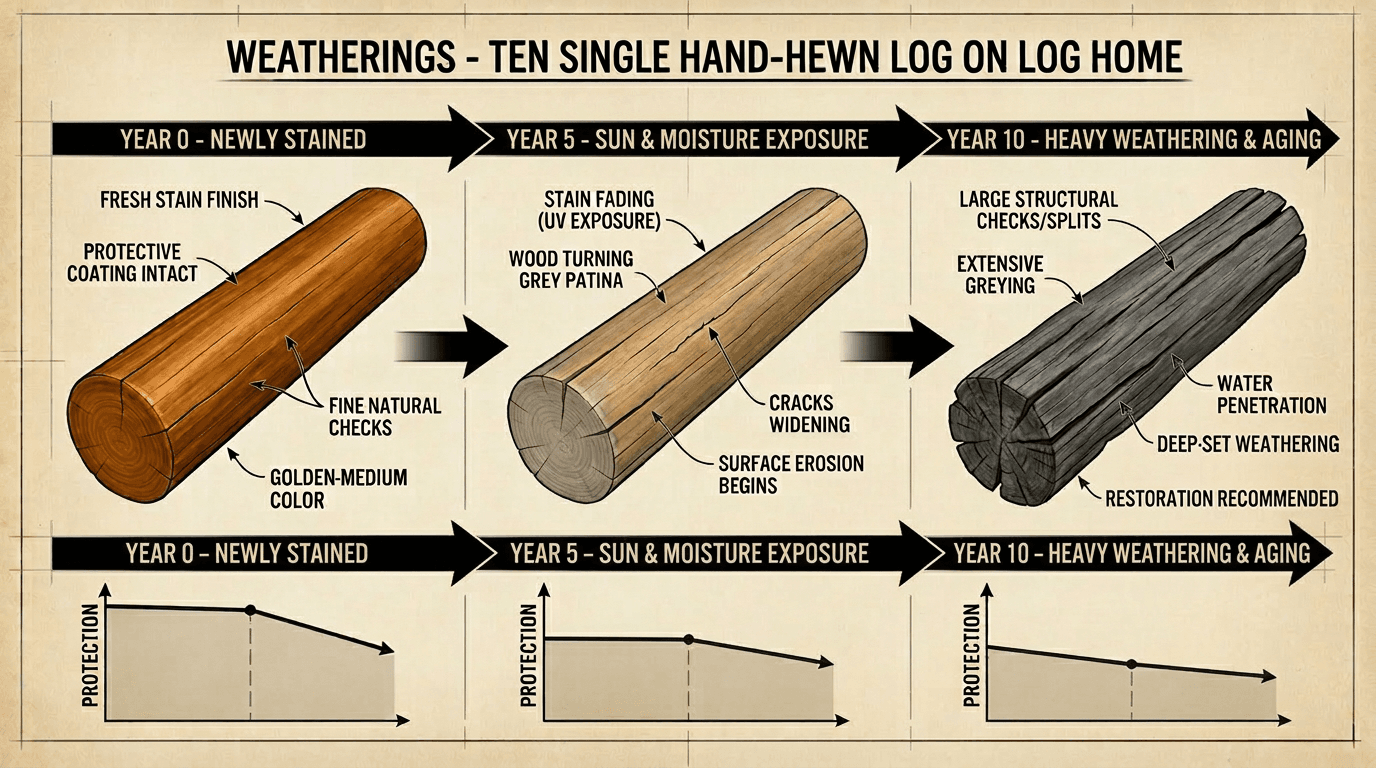
The shape of that red line is not guesswork; it follows how appraisers actually price condition. They use a cost-to-cure method — estimating what it would take to fix every deferred item — and then, as real estate resources like HAR note, they often apply a penalty on top of that, because buyers discount an obviously neglected home more harshly than the repair bill alone would justify. Nobody wants to inherit somebody else’s postponed project. So a $6,000 stain job you skipped does not cost the next owner $6,000 — it can cost you far more at the negotiating table, plus every dollar of damage the missed coat allowed. To see exactly how that physical decline unfolds year by year, our companion piece on the hidden timeline of log home decay traces a single log from fresh stain to structural rot.
Pay Now or Pay Much More Later
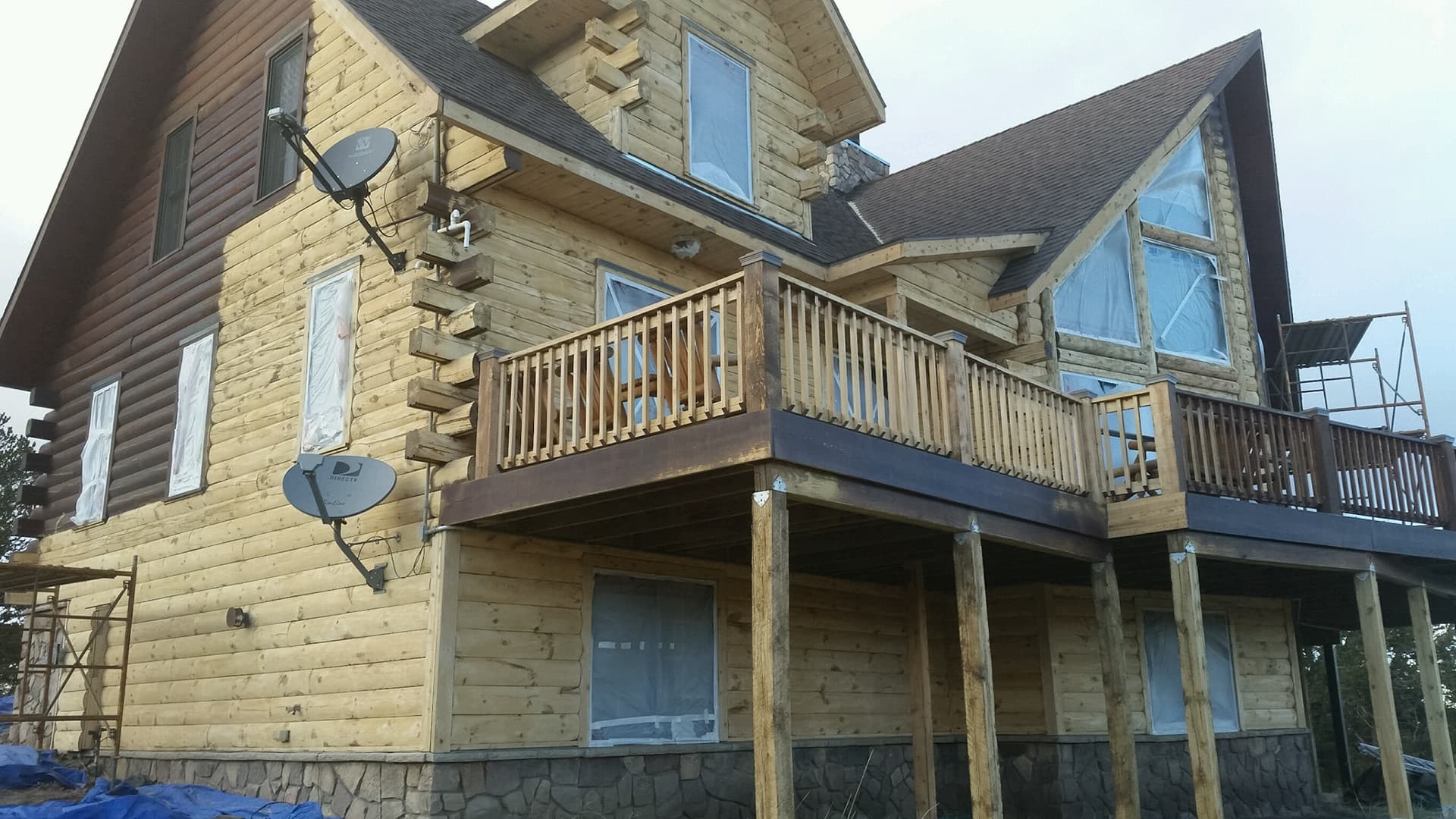
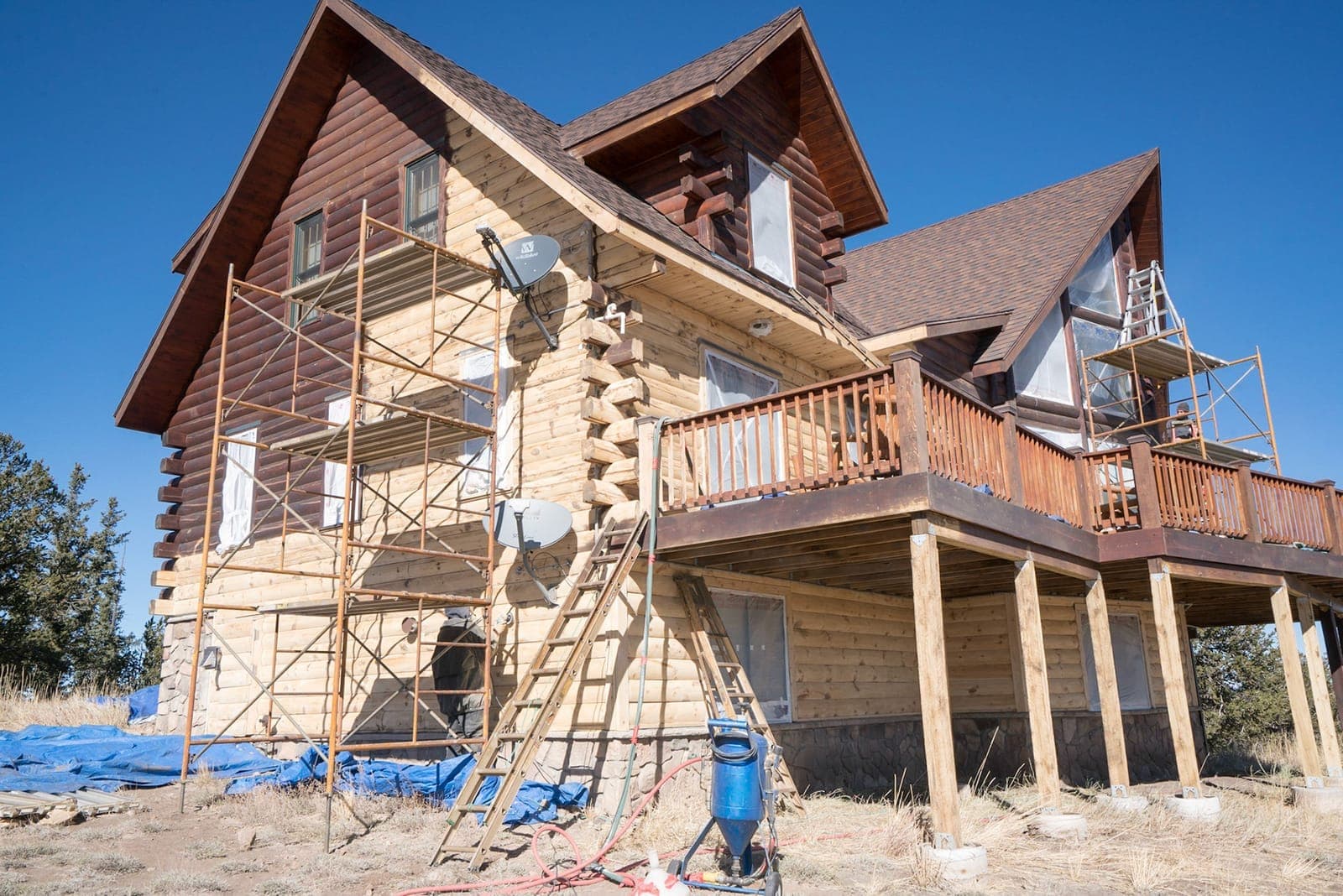
The reason the value gap compounds is that the cure gets dramatically more expensive the longer it waits. Routine maintenance is a wash-and-recoat on wood that is still sound. Once a finish fails and the wood is exposed, you cross into full restoration — media blasting back to bare log, repairing or replacing damaged timber, re-chinking, then staining and sealing. The first path costs roughly half as much per square foot as the second.
Multiply those per-square-foot numbers across a whole house and the stakes become obvious. Below is what a full restoration typically runs by home size — the bill an owner faces once maintenance has been deferred long enough that a simple recoat is no longer an option.
Read the two charts together and the lesson is simple arithmetic. A 1,500-square-foot log home kept on a maintenance rhythm might spend a few thousand dollars every several years on a wash and recoat. The same home neglected into a full restoration can face $27,000 to $30,000 or more — and that is before you count the resale discount a buyer applies for having to schedule the work themselves. Proactive chinking and staining is, quite literally, the cheapest money you will spend on the house.
Real Colorado Log Homes for Sale Right Now
None of this is abstract. Colorado’s high country is one of the most active log home markets in the country, and a quick look at today’s listings shows how directly condition drives price. The snapshot below reflects active “log cabin” listings on Zillow in two representative markets — Fairplay in Park County, and Breckenridge in Summit County — retrieved July 25, 2026.
| Market | Active log-cabin listings | List price range | Median list price | Median $/sq ft |
|---|---|---|---|---|
| Fairplay (80440) | ~40 | $185,000 – $1,499,000 | ≈ $659,000 | ≈ $414 |
| Breckenridge (80424) | ~24 | $535,000 – $12,750,000 | ≈ $1,425,000 | ≈ $839 |
The gap between the two markets — roughly $414 per square foot in Fairplay versus $839 in Breckenridge — is mostly location and land. But within each market, the homes that command the top of the range and sell the fastest are almost always the ones that show as cared-for. You can browse the live inventory yourself on Zillow’s filtered searches for log cabins in Fairplay and log cabins in Breckenridge (80424). Because inventory turns over quickly, some individual listings below may be under contract or sold by the time you read this — the pattern they illustrate does not change.
Three Listings, Analyzed
To see how maintenance and condition translate into dollars, here are three real homes currently listed — one at each end of the market, and one in the sweet spot — and what each tells us about protecting resale value.
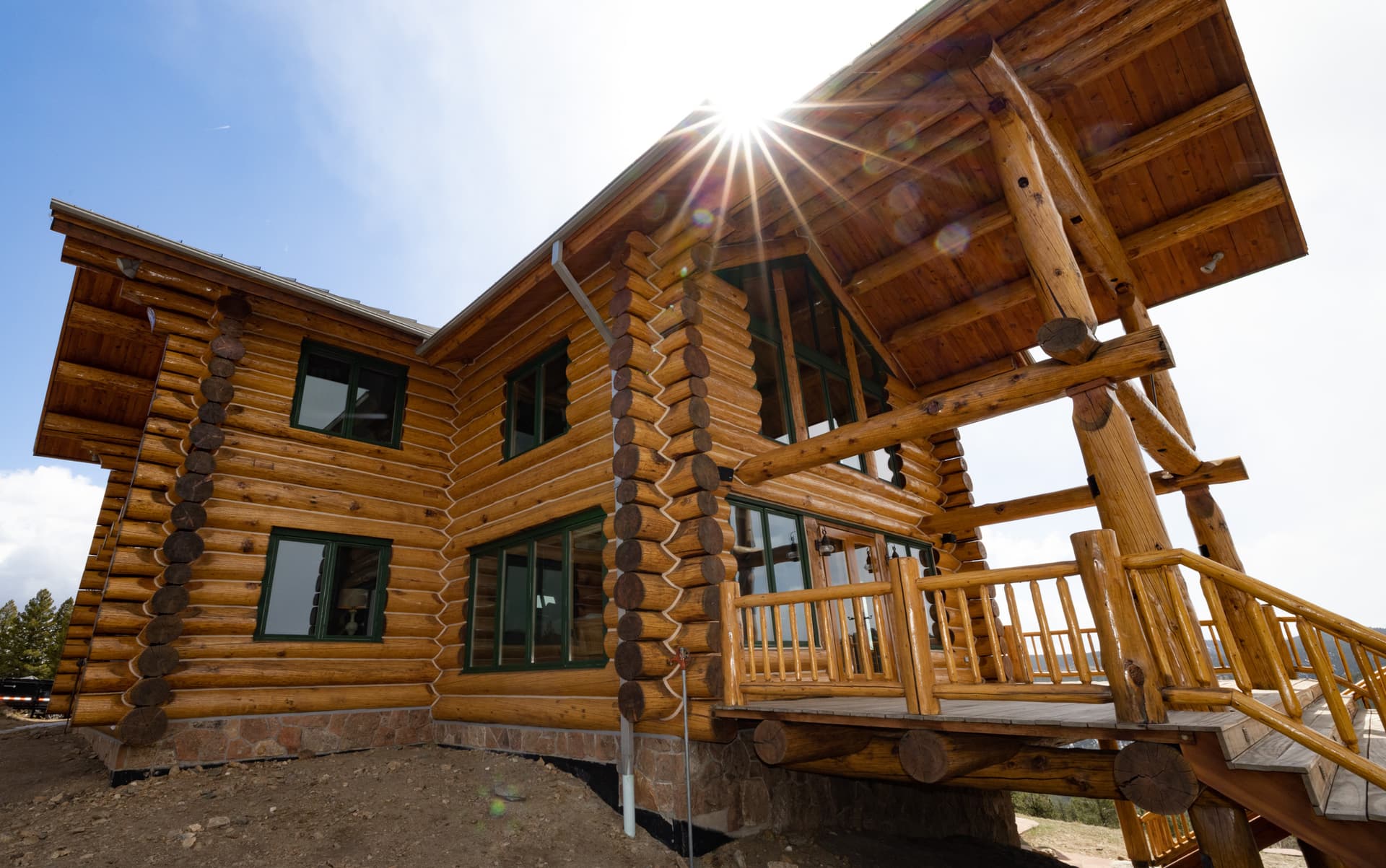
This is what maintenance looks like on a spreadsheet. A 1992 log cabin, described as “beautifully renovated,” with natural log walls, big windows, and a wrap-around deck, listed above its Zestimate and drawing heavy buyer attention — 871 views and 55 saves within nine days on the market, flagged as likely to sell faster than nearly every comparable nearby. A 34-year-old log home does not earn that kind of demand by accident. Its condition is doing the selling. The lesson for owners: a home whose logs and finish have been kept current reads as turn-key, and turn-key is exactly what commands a premium and a fast close in Summit County.
View this listing on Zillow →The opposite end of the market, and a cautionary tale. This classic off-grid log cabin sits on 30 acres along Fourmile Creek; the listing itself says it “isn’t about luxury, it’s about freedom.” Here most of the $400,000 is land, not structure — which is exactly why deferred maintenance is so dangerous on a property like this. Seasonally used, off-grid, and fully exposed at altitude, a small cabin like this is the type that quietly slides behind on staining and chinking because no one is living there to notice. Let the logs go, and a buyer stops paying for a cabin at all and starts paying only for raw acreage. The structure’s entire contribution to value depends on it staying sound.
View this listing on Zillow →The top of the Fairplay market, and the most instructive of the three. This is a newer, premium build with hand-hewn Douglas fir logs, a floor-to-ceiling stone fireplace, and turnkey short-term-rental income potential — listed at about $444 per square foot, comfortably above the Fairplay log-cabin median. Right now those logs are close to new. But a 2019 home is arriving at precisely the moment that determines its future: the first true staining and maintenance cycle. Kept on schedule, this stays a $1M-plus asset and a reliable rental. Let those Douglas fir logs weather unprotected over the next decade, and even a home this nice will drift toward the neglected line on our first chart. Fresh logs are an asset to defend, not a reason to relax.
View this listing on Zillow →For Buyers: How to Read a Log Home Before You Offer
If you are shopping for a log home, treat its maintenance history with the same seriousness you would give the roof or the foundation — because on this kind of house, the walls are the structure. A gorgeous interior can distract from logs that are two years overdue for stain, and a standard home inspection often will not catch it. Most general inspectors are not trained to spot early rot, failed chinking, checking that traps water, or the wrong stain quietly accelerating decay.
Before you write an offer, ask the seller for records: when was it last stained and with what product, when was it re-chinked, and has it ever been media blasted and restored? A well-kept log home comes with a paper trail. If the answers are vague, budget for a specialized log home inspection and price the likely work into your offer — the charts above give you the ranges. A home that needs a full restoration is not necessarily a bad buy; it is a negotiation, and now you know roughly what the chip is worth.
For Sellers: The Upkeep That Protects Your Price
If you own a log home and expect to sell within a few years, the highest-return project you can do is almost always the one that keeps you on the maintained line: a timely wash and recoat, fresh chinking where it has pulled away, and clean, documented records of it all. Buyers pay a premium for a home they can move into without a project list, and appraisers reward the condition directly. As the 231 Kimmes Lane listing shows, a cared-for log home can sell above its estimated value and faster than the field.
The mistake is waiting until the “for sale” sign is in the yard. By then, a finish that has already failed means a full restoration on a deadline, at the highest cost point on our chart, with a buyer watching the work happen. Staying ahead of the cycle year over year is cheaper, calmer, and worth more at closing. If you are not sure where your home stands today, our Colorado maintenance schedule lays out what to check and when.
The Bottom Line
For most homes, maintenance protects a depreciating structure. For a log home, maintenance protects the entire asset — because the timber you can see is the house. The numbers back it up: a well-kept home holds its value while a neglected one can shed 10% and keep falling, and the cure only gets more expensive with every skipped season. Colorado’s market makes the point in real time, where the log homes that sell highest and fastest are the ones whose owners never let the logs fall behind. Whether you are buying, selling, or simply keeping the home you love, the smartest move is the same: protect the logs, and they will protect your investment.
Frequently Asked Questions
Does regular maintenance really increase a log home’s resale value?
Yes. Proactive maintenance can add roughly 1% in value per year, while a home showing deferred maintenance can lose around 10% of its appraised value or more. On a log home the effect is amplified, because the logs are structural — buyers and appraisers price their condition directly, and a cared-for home consistently sells faster and closer to full value.
How often does a Colorado log home need to be stained and chinked?
Most log homes need re-staining every three to seven years, and the intervals are shorter at Colorado’s elevation — south- and west-facing walls can require attention every two to three years because of intense high-altitude UV. Chinking is repaired as it cracks or pulls away from the log. Annual inspections are the best way to time both for your specific home and exposure.
How much does it cost to restore a neglected log home?
Full restoration — media blasting, log repair, chinking, staining, and sealing — typically runs about $18 to $20+ per square foot of exterior log surface, or roughly $27,000–$30,000 for a 1,500-square-foot home and $90,000–$100,000 for a large 5,000-square-foot home. Routine maintenance costs roughly half as much per square foot and prevents most homes from ever needing a full restoration.
Should I buy a log home that needs work?
It can be a smart purchase — as long as you know what the work costs and negotiate accordingly. Get a specialized log home inspection, ask for maintenance records, and price any needed restoration into your offer using the ranges in this article. The danger is not a home that needs staining; it is paying a maintained-home price for a neglected home.
What should I ask a seller about a log home’s maintenance?
Ask when it was last stained and with which product, when it was last re-chinked, whether it has ever been media blasted or restored, and whether there is any history of moisture intrusion, rot, or insect damage. Clear, documented answers are a strong sign of a well-kept home; vague answers mean you should budget for a closer look.
Sources & notes: value-impact figures from appraiser Mack Strickland via Neighborly; deferred-maintenance and cost-to-cure methodology via HAR; restoration and maintenance cost ranges reflect typical Colorado log home pricing. Listing details and market figures were retrieved from Zillow on July 25, 2026 and reflect active listings at that time; inventory changes frequently. Ready to see where your home stands? Try our free log home cost calculator or request an inspection.