The Hidden Timeline of Log Home Decay: How Failing Stain Destroys Your Logs and Property Value
Your log home is more than a structure — it's a significant investment, a legacy, and a reflection of Colorado's mountain heritage. But beneath that beautiful exterior, an invisible clock is ticking. From the moment stain is applied to your logs, ultraviolet radiation, moisture, freeze-thaw cycles, and biological agents begin a relentless assault on the wood. Without timely maintenance, what starts as subtle fading can cascade into structural damage, costly repairs, and a dramatic loss of property value.
This isn't speculation — it's wood science. In this comprehensive guide, we'll walk you through exactly what happens to your logs year by year when stain protection fails, the research behind wood decay, and what you can do to protect both your home and your investment.
The Science of Wood Degradation: What Actually Happens to Your Logs
To understand why stain maintenance is so critical, you need to understand what wood is made of — and how the environment destroys it.
The Three Components of Wood
Every log in your home is composed of three primary polymers:
- Cellulose (40-50%) — The structural backbone of wood fibers, providing tensile strength and rigidity.
- Hemicellulose (25-35%) — A binding agent that connects cellulose fibers, contributing to the wood's flexibility.
- Lignin (20-30%) — The natural "glue" that holds everything together and gives wood its color and hardness. Lignin is the most critical component for understanding decay.
Here's the key fact that drives everything else: lignin absorbs 80-95% of all UV radiation that strikes the wood surface. When UV light hits unprotected wood, it targets lignin first, breaking it down through a chemical process called photodegradation. Once lignin is destroyed, the cellulose and hemicellulose beneath it are exposed and begin to deteriorate rapidly.
Your stain's primary job is to block UV radiation from reaching the lignin. When that protection fails, the chain reaction begins.
The 10-Year Decay Timeline: What Happens When Stain Protection Fails
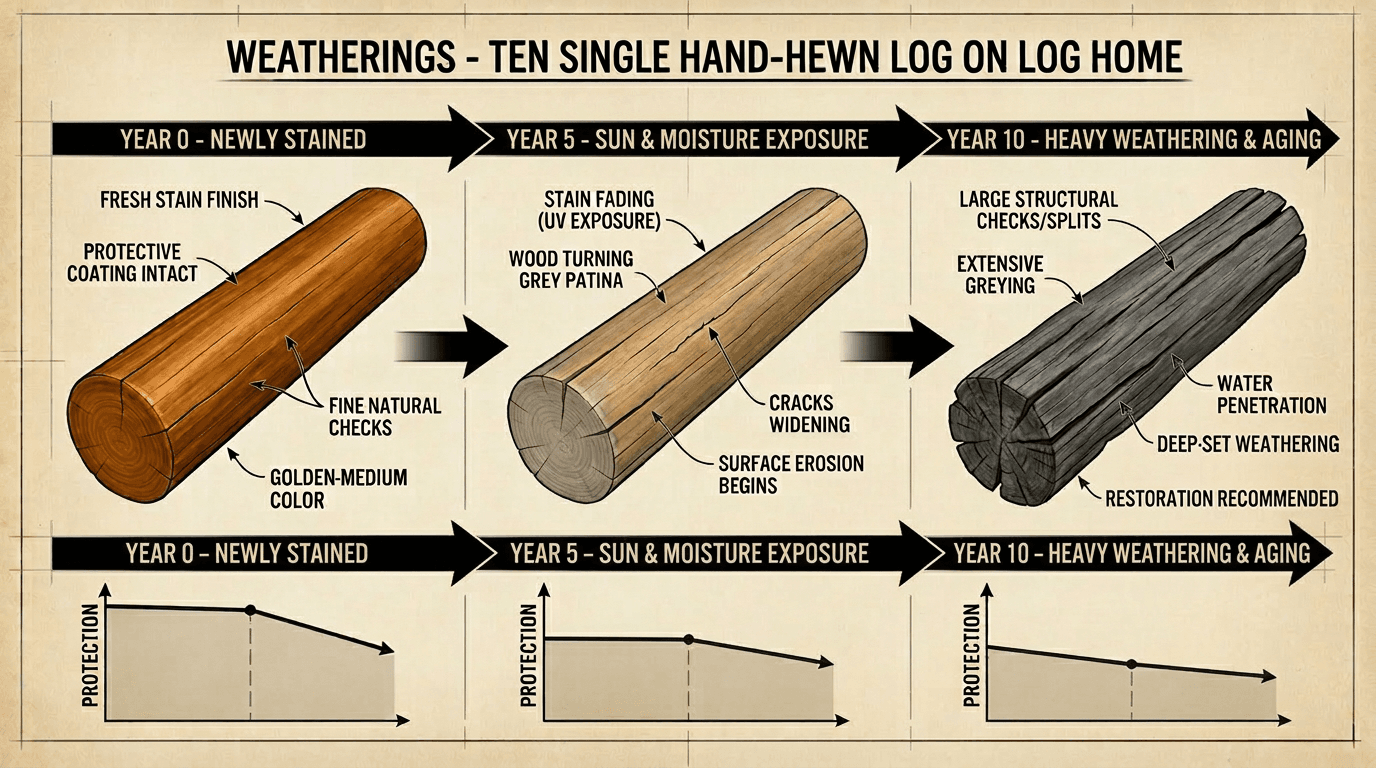
The following timeline illustrates the progressive deterioration of a typical hand-hewn log on a Colorado log home when stain is not recoated at the recommended intervals. This is based on real-world observation across hundreds of projects, combined with published wood science research.
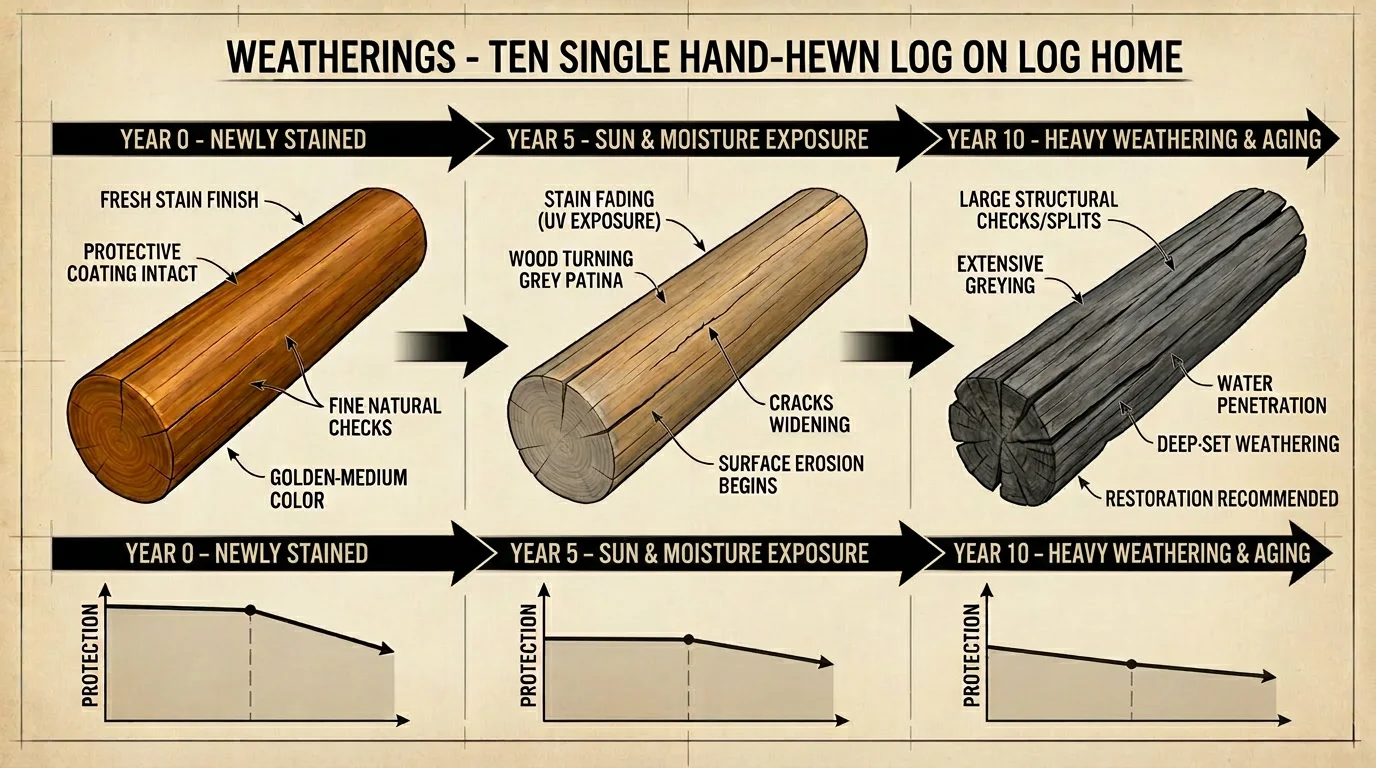
The progressive deterioration of a single hand-hewn log over 10 years without proper stain maintenance.
Year 0 — Freshly Stained: Maximum Protection
A properly applied stain system provides your logs with a comprehensive shield against the elements:
- UV-blocking pigments absorb and scatter ultraviolet radiation before it can reach the lignin.
- Water-repellent compounds prevent moisture from penetrating the wood surface.
- Fungicides and mildewcides inhibit mold, mildew, and decay fungi from colonizing the wood.
- Flexible film or penetrating resins maintain a breathable barrier that moves with the wood as it expands and contracts.
At this stage, the wood maintains its natural golden-medium color, fine natural checks are minimal, and the protective coating is fully intact. The protection-over-time curve is at its peak.
Years 1-3 — The Silent Decline Begins
During the first few years, degradation is happening — but it's largely invisible to the untrained eye. Research using FTIR-ATR spectroscopy (Fourier Transform Infrared Spectroscopy) has shown that UV photodegradation of lignin begins within just 8-24 hours of exposure to UV radiation equivalent to natural sunlight.
What's happening beneath the surface during years 1-3:
- UV pigments in the stain are gradually breaking down, reducing their ability to block radiation.
- South- and west-facing walls degrade 2-3 times faster than north-facing walls due to direct sun exposure.
- The stain's water-repellent properties begin to diminish, allowing microscopic moisture penetration.
- In Colorado's high altitude, where UV intensity is 25-60% stronger than at sea level, this process accelerates significantly.
This is the optimal window for recoating. At this stage, a maintenance coat can restore full protection at a fraction of the cost of a full restoration. Most premium stain manufacturers recommend recoating every 3-5 years — and in Colorado's high-altitude environment, every 2-3 years on south-facing walls.
Years 3-5 — Visible Deterioration: The Warning Signs
By year 5, the damage becomes visible. The stain has lost the majority of its UV-blocking ability, and the wood is now absorbing the full force of solar radiation:
- Stain fading — The once-rich color becomes noticeably lighter, especially on sun-exposed walls. UV rays have broken down and "bleached" the pigment molecules.
- Grey patina development — As lignin degrades, the wood surface begins turning grey. Research on spruce and pine species shows two distinct color changes: yellowing (from chromophore formation in degrading lignin) followed by silvering (as cellulose fibers are exposed).
- Surface erosion — The wood surface begins to feel rough and fibrous. If you can scratch across the grain with your fingernail and remove wood fiber, UV radiation has already sacrificed the lignin binding the surface fibers together.
- Cracks widening — Existing checks deepen and new ones form as the unprotected wood loses moisture rapidly, shrinks, and develops internal stress.
- Moisture penetration — Without water-repellent protection, rain and snowmelt begin saturating the outer wood layers, creating conditions for biological decay.
At this stage, restoration is still manageable — but it now requires more intensive surface preparation (cleaning, brightening, or light media blasting) before new stain can be applied. Costs increase by 40-60% compared to a simple maintenance recoat at year 3.
Years 5-7 — Accelerating Damage: The Point of No Return Approaches
Between years 5 and 7, the deterioration accelerates dramatically because the protective barriers have now completely failed:
- Extensive greying — The wood surface is now predominantly grey as UV has destroyed the lignin throughout the outer layer. The original wood color is gone.
- Deep checking — Cracks extend deep into the logs, sometimes reaching 1-2 inches or more. These cracks become channels for water to penetrate deep into the wood's interior.
- Decay fungi colonization — With consistent moisture and compromised wood fiber, brown rot and white rot fungi begin establishing colonies. Brown rot (Serpula lacrymans) breaks down cellulose, causing the wood to become brittle and crumbly. White rot attacks both lignin and cellulose.
- Insect infiltration — Wood-boring beetles, carpenter ants, and other insects exploit the softened, moisture-laden wood. In Colorado, pine beetles are a particular concern for homes near forested areas.
- Energy loss — As checks widen and chinking fails around deteriorating logs, air infiltration increases significantly. Homeowners often notice heating bills climbing 15-30% as the thermal envelope degrades.
Years 7-10 — Structural Compromise: Heavy Weathering and Aging
By year 10 without maintenance, the log has undergone fundamental structural changes that cannot be reversed with stain alone:
- Large structural checks and splits — Major cracks compromise the log's structural integrity, allowing water to reach the heartwood.
- Deep-set weathering — The surface erosion has progressed several millimeters into the wood. The degraded layer must be completely removed through media blasting before any new finish can adhere.
- Water penetration to the core — Moisture has reached the interior of the logs, creating conditions for internal rot that may not be visible from outside.
- Extensive greying and fiber loss — The log surface has lost its structural cohesion. Wood fibers are loose, raised, and actively eroding with each rain and wind event.
- Active rot — Internal decay may be progressing unseen. A simple pick test (pushing an awl or screwdriver into the wood) may reveal soft, punky wood beneath what appears to be a solid surface.
Full restoration is now required, including media blasting to bare wood, treatment of any rot, possible log replacement, complete re-staining with multiple coats, and re-chinking of all joints. The cost is typically 3-5 times higher than what a timely maintenance recoat at year 3 would have cost.
The Colorado Factor: Why Altitude Accelerates Everything
If you live in Colorado's mountain communities — Breckenridge, Vail, Fairplay, Leadville, Steamboat Springs, or anywhere above 7,000 feet — the timeline above is accelerated significantly. Here's why:
- UV intensity increases 4-5% per 1,000 feet of elevation. At 10,000 feet (Leadville, Breckenridge), UV radiation is 25-40% stronger than at sea level. At Fairplay's 9,953 feet, your stain is under relentless assault.
- Colorado averages 300+ days of sunshine per year, meaning logs receive UV exposure nearly every day — even in winter, when snow reflection (albedo effect) can double the effective UV exposure on south-facing walls.
- Extreme freeze-thaw cycles — Mountain communities experience 200+ freeze-thaw cycles annually. Each cycle drives moisture deeper into checks and cracks, then expands it as ice, physically tearing the wood apart from within.
- Low humidity and thin atmosphere accelerate wood drying, causing rapid moisture loss that leads to more aggressive checking and splitting.
- Heavy snow loads trap moisture against log walls for months during winter, creating persistent wet conditions that promote decay.
The practical impact: stains that might last 5-7 years at lower elevations may only protect for 2-4 years in Colorado's high country. South-facing walls at altitude can lose effective protection in as little as 18-24 months.
The Financial Impact: How Neglected Maintenance Destroys Property Value
The damage isn't just physical — it hits your wallet directly through decreased property value. Understanding the financial consequences of deferred maintenance is critical for every log home owner.
What Home Inspectors and Appraisers Look For
When your log home is appraised or inspected for sale, professionals evaluate the condition of the logs as a major factor in determining value. In real estate appraisal, deferred maintenance is classified as physical depreciation — a direct reduction in the property's assessed value.
Fannie Mae and Freddie Mac use the Uniform Appraisal Dataset (UAD) condition ratings, where properties with significant deferred maintenance can be rated C4 ("needed repairs and refinishing") through C6 ("substantial damage"). Each step down the scale represents a measurable loss in appraised value — often 10-25% or more for log homes with visible decay.
The Real Numbers: Cost of Neglect vs. Maintenance
| Scenario | Estimated Cost | Property Value Impact |
|---|---|---|
| Maintenance recoat (Year 3) | $4,000 – $8,000 | Preserves or increases value |
| Delayed restoration (Year 5-7) | $12,000 – $25,000 | 5-10% value reduction |
| Full restoration (Year 8-10) | $25,000 – $50,000+ | 15-25% value reduction |
| Structural repair + log replacement (Year 10+) | $50,000 – $100,000+ | 25-40% value reduction; buyers may walk away |
Consider this: a $500,000 log home that loses 20% of its value due to neglected wood maintenance has effectively lost $100,000. That $100,000 loss could have been prevented entirely with $12,000-$20,000 in timely stain maintenance over a 10-year period. The return on investment for regular log home maintenance is extraordinary — every $1 spent on timely maintenance saves $5-$8 in future restoration costs and preserved property value.
Why Buyers Walk Away from Neglected Log Homes
Nothing kills a log home sale faster than visible wood decay. When home inspectors find rot, buyers face a stark choice: negotiate a steep discount to cover restoration costs, or walk away entirely. Most choose to walk away.
Key concerns that drive buyers away include:
- Visible grey, weathered logs signal years of neglect and raise questions about what other maintenance has been deferred.
- Cracked or missing chinking indicates air leaks and potential moisture damage between logs.
- Soft or punky wood discovered during inspection means active rot that may extend far beyond the visible damage.
- Uncertain repair costs — buyers fear the unknown scope of hidden damage, and many simply won't take the risk.
- Lending concerns — severely deteriorated log homes may not pass FHA or conventional loan inspections, limiting the buyer pool to cash purchasers and further depressing the sale price.
How Different Stain Types Perform Over Time
Not all stains are created equal. The type of finish on your log home directly determines how long your protection lasts before recoating is needed:
| Stain Type | Expected Lifespan | UV Protection | Best For |
|---|---|---|---|
| Clear water repellent | 6-12 months | Minimal | Temporary protection only |
| Semi-transparent oil stain | 2-4 years | Moderate | Natural wood grain visibility |
| Water-based acrylic stain | 3-5 years | Good | Flexibility and color retention |
| Film-forming acrylic system | 5-7 years | Very Good | Maximum protection in harsh climates |
| Acrylic + clear topcoat system | 7-12+ years | Excellent | High-altitude, severe exposure |
Critical note for Colorado homeowners: These lifespans are based on typical conditions at lower elevations. At Colorado mountain altitudes (7,000-10,000+ feet), reduce expected lifespan by 30-50% on sun-exposed walls. A stain rated for 5 years at sea level may only last 2.5-3.5 years on a south-facing wall in Breckenridge.
The Five Warning Signs Your Stain Has Failed
Don't wait until your logs are visibly grey and cracked. Learn to recognize the early warning signs that your stain protection is failing:
- The Water Bead Test Fails — Spray water on your logs. If water beads up and rolls off, your stain is still working. If water soaks into the wood and darkens the surface, the water-repellent has failed. Perform this test annually, especially on south-facing walls.
- Color Fading and Inconsistency — Compare sun-exposed walls to shaded or north-facing walls. Significant color difference indicates UV degradation of the stain pigments on exposed surfaces.
- Surface Feels Rough or Fibrous — Run your hand across the logs. If the surface feels rough, fuzzy, or raised (especially after rain), the wood fibers are lifting because the lignin that held them together has been destroyed.
- Grey Patches Appearing — Any greying of the wood surface means UV has penetrated past the stain and is actively destroying lignin. This is an urgent signal to recoat.
- Checks Are Deepening or Multiplying — While some checking is natural, rapidly deepening or multiplying checks indicate the wood is losing moisture too quickly due to failed stain protection.
The Maintenance Schedule That Protects Your Investment
Based on wood science research and our 20+ years of experience restoring log homes across Colorado's mountain communities, here is the maintenance schedule we recommend:
Recommended Log Home Maintenance Timeline
- Annually: Visual inspection of all walls. Perform water bead test. Check chinking and sealants. Clean debris from log surfaces and around foundation.
- Every 2-3 years (south/west walls at altitude): Maintenance recoat on sun-exposed walls. Clean surface, apply one coat of matching stain.
- Every 3-5 years (all walls): Full maintenance recoat. Clean all surfaces thoroughly, apply one to two coats of UV-blocking stain.
- Every 7-10 years: Comprehensive inspection for rot, insect damage, and structural issues. Repair or replace damaged chinking. Address any checks deeper than 1/4 inch with flexible sealant.
- As needed: Emergency repairs after severe hail, wind events, or fallen trees. Address any water intrusion immediately — do not wait for scheduled maintenance.
The bottom line: A disciplined maintenance schedule is the single most cost-effective investment you can make in your log home. Regular recoating prevents the cascade of degradation that leads to expensive full restorations, protects your property value, and keeps your log home looking beautiful for generations.
When It's Too Late for Maintenance: The Restoration Process
If your logs have passed the point where a simple maintenance recoat will be effective — if you're seeing significant greying, deep checks, soft wood, or visible decay — a full restoration is necessary. Here's what that process involves:
- Assessment and inspection — Thorough evaluation of all log walls, checking for hidden rot with moisture meters and pick tests. Structural engineering assessment if significant decay is found.
- Media blasting — Removal of all old, failed finish and degraded wood fiber using corn cob, walnut shell, or crushed glass media. This reveals clean, sound wood beneath the weathered surface.
- Rot treatment and log replacement — Any rotted sections are treated with borate preservative or replaced entirely with matching logs. This is where costs escalate significantly if damage is extensive.
- Sanding and surface preparation — After blasting, logs are sanded smooth and any remaining debris is removed to ensure optimal stain adhesion.
- Borate treatment — Application of borate-based wood preservative to protect against future insect and fungal damage.
- Stain application — Multiple coats of premium UV-blocking stain are applied, often with a clear topcoat for maximum protection. Proper application requires specific temperature and humidity conditions.
- Chinking and caulking — All joints between logs are re-sealed with flexible chinking and caulk to prevent air and moisture infiltration.
A full restoration project for a typical Colorado log home ranges from $25,000 to $75,000 or more, depending on the size of the home and severity of damage. Compare that to the $4,000-$8,000 cost of a timely maintenance recoat — the math speaks for itself.
Protect Your Investment Before It's Too Late
Your log home is likely one of the largest investments you'll ever make. The science is clear: without regular stain maintenance, UV radiation will systematically destroy the lignin that holds your wood together, moisture will accelerate decay, and your home will lose both its beauty and its value.
The good news is that this damage is entirely preventable. A proactive maintenance schedule — with regular inspections, timely recoating, and prompt attention to any signs of stain failure — will keep your log home protected, beautiful, and valuable for decades to come.
If you're unsure about the current condition of your stain, or if it's been more than 3 years since your last maintenance coat, we encourage you to schedule a free inspection. Our team has over 20 years of experience evaluating log homes across Colorado's mountain communities, and we can tell you exactly where your home stands on the decay timeline — and what it will take to protect it.
Schedule Your Free Log Home Inspection
Don't wait until your logs are telling you it's too late. Contact Log Home Finishing LLC today for a thorough, no-obligation assessment of your log home's condition.
Call (719) 301-3917 or request a free estimate online