How Colorado’s Climate Deteriorates Log Homes Without Maintenance
How Colorado’s Climate Deteriorates Log Homes Without Maintenance
Introduction
Log homes exude rustic charm and natural beauty, but they are not “set-and-forget” structures. In Colorado’s mountain climate – with its intense high-altitude UV sunlight, dry air, and seasonal snow – unprotected logs can deteriorate rapidly. If a log home isn’t regularly maintained with protective stain and proper chinking (the sealant between logs), the wood will suffer from UV exposure, moisture infiltration, and wood degradation. Over time, sun and weather cause logs to crack, check, and even rot, compromising both appearance and structural integrity. This post explores how different log profiles (round logs, square/flat logs, and D-logs) react to these environmental factors, the physical and chemical changes that occur in sun-bleached and waterlogged wood, and the engineering behind maintenance techniques like staining, chinking, and media blasting. We’ll cite industry experts (Sashco, Perma-Chink, and restoration professionals) to understand why proactive maintenance is critical for log homes, especially in places like Colorado.
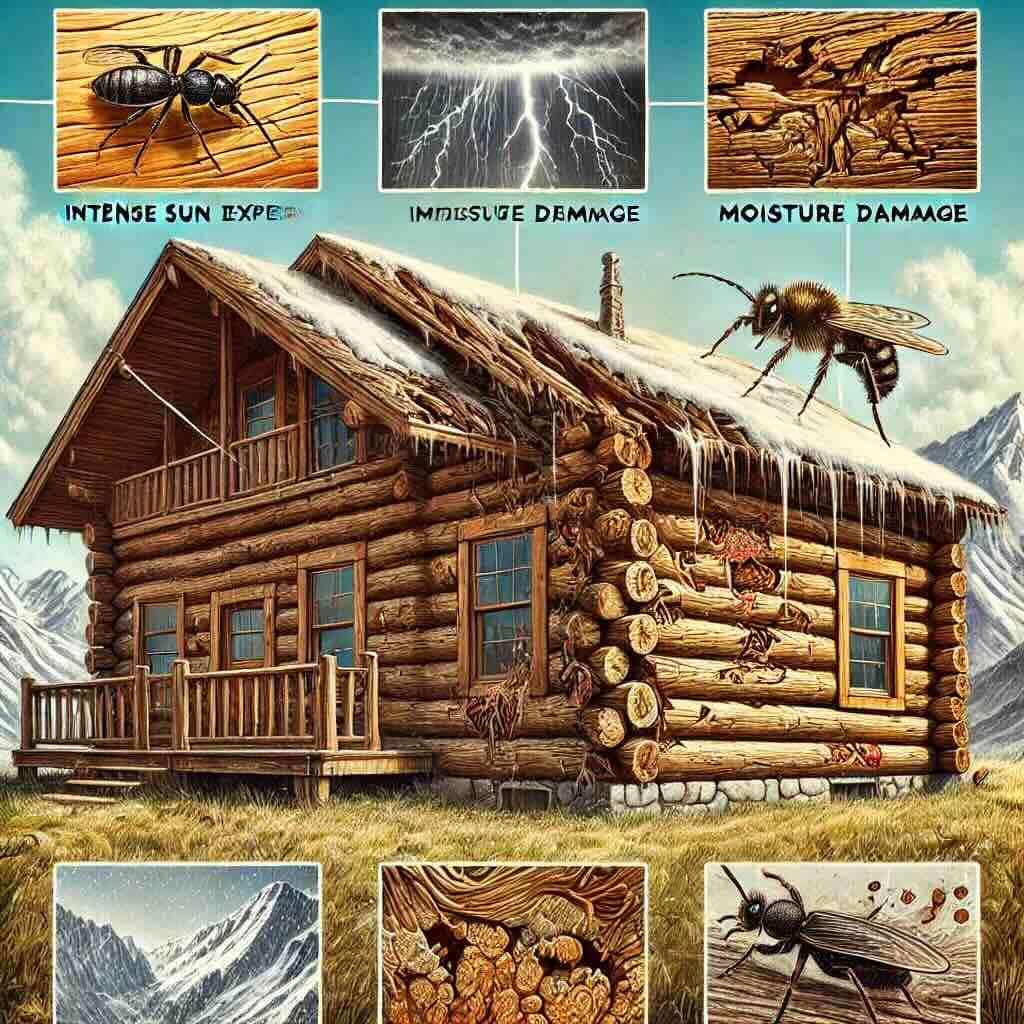
(Figure 1: Illustration of how UV exposure and moisture affect different log profiles over time – round vs. flat vs. D-log.)
Colorado Mountain Climate: A Perfect Storm for Log Decay
Colorado’s mountain regions present a harsh environment for wood structures. The high altitude means more intense UV radiation – the air is thinner, so there’s less atmosphere to filter the sun’s ultraviolet rays. According to log home specialists, Colorado’s sunny climate “can cause UV damage to untreated or poorly stained wood” . In practical terms, logs here get “sunburned” faster than in lower elevations. Summers bring long days of bright sun that photochemically break down the wood’s surface, while winters introduce moisture in the form of snow and ice. The air is generally dry year-round, which causes wood to lose moisture content and shrink. But when precipitation does occur, it can soak into exposed wood (especially during spring snowmelt or summer thunderstorms), only to freeze at night or evaporate quickly in the dry air. These cycles of wetting and rapid drying, plus freeze-thaw, put tremendous stress on log structures.
UV Exposure: At 8,000 feet elevation, UV levels are significantly higher than at sea level. The southern and western faces of a log home, which get the most sun, are often the first to show damage. In fact, experts note that hot summer months do more damage than cold winters when it comes to wood weathering . While snow and ice sitting on logs can be harmful, the sun’s rays inflict the most long-term damage by degrading the wood’s surface chemistry.
Moisture and Precipitation: Though Colorado is relatively dry, log homes still face rain, wet snow, and dew. The issue is not constant dampness (as in a rainforest) but periodic moisture infiltration into wood that has been dried out by sun. When thirsty, unsealed logs absorb water, they can swell and soften, and any water that gets deep into joints or cracks may linger. Logs in Colorado might go from 0% moisture to saturation and back in short time spans. Freeze-thaw cycles then come into play: water that seeps into a crack can freeze overnight, expanding about 9% in volume and widening the crack. Over a few seasons, small checks can split further due to this freezing expansion . In addition, snow accumulation against logs (especially on horizontal surfaces or upward-facing checks) keeps wood wet for extended periods, which promotes decay once temperatures rise.
Key takeaway: Colorado’s climate accelerates the very processes that damage wood – strong UV light, fluctuating moisture, and freeze-thaw stresses. A log home here must be diligently protected against these elements to avoid rapid deterioration.
UV Radiation: Sunlight vs. Wood
Sunlight’s ultraviolet component is a primary culprit in log home deterioration. UV rays break down wood at the molecular level. One industry article explains that UV light “changes or destroys the wood’s lignin”, the natural glue that hardens and binds wood fibers, in a process called photo-oxidation . Lignin is what gives wood much of its strength and color; when it deteriorates, the wood fibers (cellulose) are exposed and weakened. Here’s what prolonged UV exposure does to logs:
• Surface Color Change (Graying): The first visible sign is that the wood turns from its fresh brown/tan hue to a dull yellow, then gray. This graying is essentially wood oxidation. In dead wood (like your log walls), UV-exposed wood fibers oxidize and eventually take on a silvery-gray patina . Some homeowners find this rustic aging appealing, but it’s actually a symptom of damage. The gray layer is brittle, UV-burnt wood where lignin has been lost. If the home is not evenly exposed to sun (e.g. north vs south walls), the graying will be patchy and uneven, marring the home’s appearance .
• “Sunburn” and Fiber Erosion: Just as intense sun can burn and peel human skin, logs can suffer a kind of sunburn. A log that’s unprotected will start to dry out and even blister, crack, or peel at the surface under intense sun . The damaged lignin can no longer hold the wood fibers tightly, so the outermost layer might slough off or become “fuzzy.” You might notice small splinters or powdery wood dust on very sunburned logs – a sign the wood’s surface cells are disintegrating. This surface erosion not only looks bad, it exposes fresh wood below to further UV and moisture, accelerating the cycle of damage .
• Differential Expansion & Finish Breakdown: Sunlight also heats the wood, causing it to expand. Daily heating and cooling can create micro-movements in the logs. If a log wall has a protective stain or finish, UV radiation and heat will attack that finish too, causing it to fade and degrade. An inflexible film finish (like an old polyurethane or improper paint) may start to crack under UV and thermal stress . This is why high-quality log stains are typically breathable and UV-resistant. If the finish cracks, it opens pathways for water to get in, defeating its purpose. In Colorado’s sun, even good stains need reapplication more frequently – UV inhibitors get “used up” over time as they sacrificially absorb radiation .
• High-Altitude Intensity: It’s worth noting that for every 1,000 feet of elevation, UV levels increase by around 4-5%. At Colorado elevations, logs are being hit with significantly more UV than the same structure at sea level. One Colorado log home service notes the climate “can cause UV damage to untreated or poorly stained wood” and recommends choosing stains with strong UV blockers for this reason . Simply put, the sun is a formidable foe for log homes in the mountains.
Engineering insight: Studies have shown that even one week of direct sun on bare wood can cause measurable damage to the wood cells and reduce a stain’s ability to adhere . That’s why freshly sanded or blasted logs should be stained as soon as possible – wood begins to “sunburn” almost immediately when unprotected. UV degradation is a chemical change (breaking molecular bonds in lignin), but it leads to physical changes (color loss, fiber weakness and cracking) in the logs.
(Figure 2: Cross-section diagram of log profiles with chinking, showing how a proper chinking seal prevents water infiltration and damage in round logs vs. flat logs vs. D-logs.)
Moisture Infiltration: Water vs. Wood
Water is the other great enemy of log homes. Wood is a porous, hygroscopic material, meaning it absorbs and releases moisture depending on the environment. In a living tree, bark and natural oils protect the wood interior from water and decay. In a log home, those defenses are gone – it’s up to your stain and sealants to play that role. When logs are left bare or when seals fail, moisture will find its way in.
What happens when logs get wet? A host of problems can ensue:
• Rot and Fungal Decay: If water penetrates and lingers in wood, it creates a breeding ground for wood-decaying fungi. These microscopic organisms eat the wood, breaking down cellulose and lignin in a chemical process similar to composting – not something you want happening in your walls! Perma-Chink (a leading log home product company) experts put it bluntly: “When water penetrates wood, it can contribute to rot and weakens a log’s structural integrity, making it even easier for insects to get into the logs. Moisture in logs also provides an inviting environment for fungi, whose growth will expedite a log’s decomposition.” In nature, dead logs eventually turn to soil thanks to fungi; in your home, unchecked moisture could literally turn your logs to mush over the years. Rot can be brown rot (wood dries into crumbly brown cubes) or white rot (wood becomes spongy and bleached). Both types severely weaken the wood fibers. Importantly, wood can be mostly sound on the surface yet rotting inside if water is entering through unseen gaps – by the time rot is visible outside, significant damage may be done internally .
• Mold and Mildew: Even before serious rot sets in, persistent dampness supports surface molds and mildews. These can discolor the logs (black, grey, or green patches) and make for an unsightly appearance. For accurate cost estimates on log home restoration projects, our calculator helps you plan your maintenance budget. Mold itself doesn’t always destroy wood, but it’s a red flag that conditions are wet enough for worse problems to follow. Moldy logs also pose health concerns (spores) for the occupants.
• Insect Infestation: Wet, decaying wood is an open invitation to wood-boring insects. Carpenter ants, termites, bark beetles and other pests love softened wood. One log restoration company notes that rot not only weakens wood directly, it “attracts carpenter ants, termites, and other pests, further degrading the wood” . These insects can accelerate the hollowing out of logs, turning a small damp spot into a structural void. Dry wood is far less appealing to pests, so keeping logs sealed and dry is a key part of pest prevention.
• Swelling, Warping, and Fiber Damage: Wood expands as it takes on moisture. Repeated wet/dry cycles cause the wood to swell when wet and shrink when dry. This movement can lead to warping or twisting of logs over time if one side consistently gets wetter than another. Moisture can also raise the grain of the wood, causing a rough surface. If a film-forming finish or paint is on the log, moisture coming from inside can cause that finish to blister or peel off (as the pressure of water vapor breaks the adhesion). In fact, blistering of a finish can occur if logs weren’t dry enough when coated or if water gets behind the stain . Each blister or peel exposes bare wood, which then starts the UV damage cycle – a vicious circle.
• Faster Decay in Unsealed Gaps: The most vulnerable spots are wherever water can “sit” or get trapped. For example, log corners, upward-facing checks, and areas between logs with poor chinking are common failure points. As one restoration guide explains, “Log rot occurs when water can sit undisturbed, penetrating the wood and breaking down its fibers, leading to decay.” If a gap between logs isn’t sealed, rain can seep or be driven by wind inside the wall assembly. That hidden moisture might take a long time to evaporate, meanwhile feeding rot and mold. Within just a couple of years of chronic leaks, a log can become structurally unsound. In fact, specialists warn that without proper sealing, “logs can rot within two to three years, potentially leading to the loss of the entire cabin within ten to twenty years” . That scenario is for a severely neglected structure, but it underscores how relentless moisture damage can be.
Freeze-Thaw Mechanics: In Colorado, moisture issues are compounded by freezing temperatures. Any water trapped in wood pores or small cracks will freeze and expand, prying the wood fibers apart. Over a winter of repeated freeze-thaw cycles, this can turn a hairline crack into a gaping split. Sashco’s experts note that moisture which stays in a log and freezes “causes more severe checking” as the ice forces the crack open . So, a crack begets water, water begets a bigger crack – a self-worsening problem if not addressed.
Key takeaway: Moisture intrusion is the catalyst for rot, mold, and insects – the biological and chemical degradation of wood. Keeping water out of the logs (and promptly dealing with any dampness that does occur) is absolutely critical for a log home’s longevity. In engineering terms, wood should be kept below about 20% moisture content to avoid rot; above that, decay fungi can flourish. Maintenance strategies like staining and chinking are largely aimed at moisture control, which we’ll discuss later.
Checking and Cracking: The Wood’s Response
Logs are massive pieces of wood, and as they dry out over time, they inevitably develop checks – which are the cracks or splits along the grain. Checking is a natural process caused by the shrinkage of wood as it loses moisture. Think of it this way: when a log is first cut, it often has a high internal moisture content. As it comes into equilibrium with the dry mountain air, the outer layers of the log dry and shrink faster than the inner core, pulling apart the wood and causing a split. All log species and profiles will develop some checks, and small checks are generally not a structural concern . In fact, log home builders often say checks are a sign the log is dry and stable. However, the size, frequency, and orientation of these cracks can significantly affect durability if not managed.
Here’s how different log profiles experience checking and cracking, and why it matters:
• Round Logs (Full Logs): Large round logs (like those in a full-scribe or Swedish cope log home) can develop substantial checks because of their large diameter. Often, a round log will crack on the side where the heartwood is closest to the surface. Builders sometimes orient logs so that major checks occur facing inward or downward for better protection. The orientation of the check is critical: upward-facing checks are problematic because they catch rain like a trough. A deep crack on the top of a round log can funnel water *“directly into the interior of the log” , where it soaks in and can lead to internal rot. Round logs have a curved surface, so the upper curvature gets the brunt of sun and rain. It’s noted that the top third of a round log suffers the most intense weathering – UV bombardment and moisture – while the bottom third is somewhat shielded . Consequently, checks in the upper arc of a log are both more likely and more dangerous. These should be sealed (with caulk or epoxy) to prevent water intrusion. If left open, an upward check in a round log essentially becomes a “pipeline” for decay. Over time, round logs may also experience radial cracks that grow longer and wider; these don’t usually split the log in half, but a big one can penetrate deep towards the center. While one isolated crack might not compromise structural strength, multiple large checks can slightly reduce a log’s cross-sectional area and insulation value. More importantly, they collectively expose more inner wood to hazards.
• Square or Flat Logs (Timber-Style): Square logs (also called rectangular timbers or “square profile” logs) present a flat face to the exterior. These are often milled logs with flat top and bottom surfaces that stack without a gap. They tend to dry a bit more uniformly than full rounds. A flat log will often develop smaller, surface cracks across its width or along the grain, but because of the flat vertical orientation, any checks are less likely to collect standing water. Experts point out that with vertical faces, *“even upward facing checks are not as prone to rainwater entering the logs” – basically, gravity helps water run out of the crack rather than in. Additionally, because the sun hits a flat log wall at an even angle, UV exposure is uniform across the surface . This means the entire face weathers at roughly the same rate; you won’t see the extreme top vs. bottom differences that round logs have. As a result, maintenance (like re-staining) is a bit easier to manage on square logs, since you’re dealing with an even playing field of sun damage . That said, flat logs can still crack at the corners or ends, and shrinkage gaps can open between logs if the gaskets or seals between them fail. The corners (especially if they are **“butt-and-pass” style, where log ends extend out) create little flat ledges of wood that can catch rain and snow. Those areas need careful sealing and perhaps flashing to prevent rot. In terms of checking, a well-dried square log might develop only hairline cracks, whereas a “green” (not fully dried) timber could still open substantial checks as it cures in place. Regular inspection is needed to caulk any developing gaps in a square log wall, particularly around windows and door frames where cut logs end.
• D-Logs (Round-One-Side): D-logs are a popular profile for milled log homes – flat on the interior side and round on the exterior, resembling a “D” in cross-section. They combine characteristics of both round and flat logs. The exterior round face of a D-log will behave much like a smaller round log: the upper curvature gets more sun exposure and can develop sun cracks, and if any check forms that faces upward, it must be sealed. However, many D-log systems include a tongue-and-groove or spline that interlocks the logs, which can reduce the chance of large gaps forming between logs. Typically, manufacturers also kiln-dry D-logs to a certain extent, which helps minimize large checks (though it doesn’t eliminate checking entirely). The flat top and bottom of a D-log means the stacking surface is broader and often sealed with foam tape or caulk during construction. Ideally, a D-log wall has no visible chinking line – the logs fit snugly. But if the logs shrink or were not perfectly milled, small gaps can appear on the exterior seam. These are often thin and can be addressed with a clear caulk (sometimes called an energy seal). It’s important not to ignore those hairline seams, because wind-driven rain can still creep in. One advantage of D-logs: since the interior side is flat, they don’t present the deep crevices inside that full rounds do – meaning less places for air leakage and no interior chinking needed. They are somewhat easier to build and seal (the flat side simplifies wiring, finishing, etc.). However, on the outside, you still have a curvature that will weather like any round log. In summary, D-logs need the same exterior care as round logs – quality staining and UV protection, and periodic inspection of log seams and any checks – but they tend to have fewer and smaller gaps to manage if properly installed. Checking in D-logs is usually minor if the wood was dried; you might see a few short cracks on the rounded face, which should be stained and sealed like any other.
No matter the profile, log ends are another area to watch. The cross-cut ends of logs (where the grain is exposed) can soak up water like straws. Many log homeowners apply special end-grain sealers to minimize this. Corner joints (saddle-notch, dovetail, etc.) also need monitoring, as they can open slightly or collect debris and water.
Why Checking Needs Attention
A “check” might seem like just a cosmetic flaw, but as we’ve emphasized, if it’s wide enough to admit water, it becomes a problem. How wide is too wide? A good rule of thumb from Sashco is: any crack wider than 1/4 inch should be sealed, especially if it faces upward . Sashco explains that checks of that size can take on enough water to create “localized regions of very high moisture content” in the wood – leading to mold, rot, finish peeling, and freeze expansion damage . So part of log home maintenance is inspecting for new checks and deciding if they need caulking. Often, very small or downward-facing checks can be left alone (the stain will still need to reach inside them), but larger ones get a bead of specialized log caulk or epoxy resin to keep water out. It’s a delicate balance because you don’t want to trap moisture in either – the sealant used must be flexible and breathable.
In engineering terms, a check is a stress relief mechanism for the wood – the log relieves internal tension by cracking rather than continuing to shrink evenly. While one might think a crack compromises strength, in thick logs the majority of checks do not go all the way through the log or significantly weaken it . The structure remains sound as long as rot doesn’t set in. So the primary concern with checks is not loss of strength, but moisture management. Think of each crack as a potential leak that needs plugging unless it’s naturally self-draining.
The Chemistry of Wood Degradation: Why Logs Decay
From an engineering and materials science perspective, the deterioration of logs is a combination of physical weathering and chemical/biological degradation. Let’s briefly look at the science behind what’s happening to an unprotected log over time:
• Photo-Oxidation of Lignin (UV Damage): Wood is composed mainly of cellulose fibers (which are pale and strong) glued together by lignin (a dark, complex polymer that gives wood its color and rigidity). UV radiation carries enough energy to break the chemical bonds in lignin. The term “photo-oxidation” describes how UV + oxygen cause lignin to oxidize into smaller molecules. This manifests as color change (UV-broken lignin turns wood gray) and as a loss of surface cohesion (the wood fibers become loose without lignin binding them) . The gray layer on old sun-exposed logs is essentially lignin-depleted wood. It is weaker and more porous than the undamaged wood beneath. Also, lignin normally helps resist rot; some wood-decay fungi specifically consume lignin (as in white rot), leaving soft cellulose. So UV pre-damage actually makes it easier for fungi to attack, since it’s like pre-digesting the lignin. Bottom line: UV exposure is a chemical degrader that sets the stage for further damage.
• Hydrolysis and Weathering: Sun and rain together cause hydrolysis of wood components – breaking them down with water. Alternating wetting and drying can chemically alter wood as well, leaching out natural extractives and even nutrients that fungi might then use. Wind can carry abrasive dust that scours the wood surface. Over years, this weathering erodes a thin layer of wood. Researchers have found that bare wood exposed even briefly loses some ability to hold finishes because the surface cells are weakened . Thus, the chemistry of weathering directly ties into maintenance: a weathered log won’t take stain as well until you remove or condition that damaged layer.
• Wood Equilibrium Moisture Content (EMC): A bit of engineering data – wood in a given climate will stabilize at a certain moisture content (EMC). In humid climates, it might be 12-15%, in Colorado’s dry air it’s lower (often around 9-10% EMC) . This means logs in Colorado dry more thoroughly, which is good for avoiding rot, but the drying process can be more severe (leading to more checking). If logs were not pre-dried to that range, they will continue to shrink in place until they reach EMC. Also, whenever wood’s moisture exceeds the EMC (after a rain, for instance), it will later dry back down – that cycle causes stress. The EMC concept explains why properly dried logs experience less dramatic movement over time. Some builders source logs from climates similar to the build site (e.g., high-altitude kiln-dried logs for a high-altitude home) .
• Fungal Metabolism (Rot): Wood rot is fundamentally a biochemical process. Fungi spores are practically everywhere; they land on wood and if moisture and temperature conditions are right (>20% moisture, moderate warmth), they germinate and grow hyphae into the wood. These fungi secrete enzymes that break down wood’s components: cellulases to digest cellulose (as in brown rot, which leaves behind brown lignin and causes wood to crumble) and laccases/peroxidases to digest lignin (as in white rot, which leaves a whitish cellulose matrix). The byproducts are simpler compounds the fungi uses as food. This process can progress surprisingly fast in wet wood – a section of log can become spongy in one summer of being soaked. Chemically, rot is irreversible damage. The only solution is to remove or structurally reinforce rotted sections (there are epoxies that can harden punky wood, but they’re not a substitute for keeping wood dry in the first place). It’s also worth noting a special case: “dry rot” is a misnomer; all rot needs moisture. What people call dry rot is usually wood that was wet, rotted, then dried out again (leaving it dry but structurally gone).
• Thermal Effects: Logs see significant thermal swings (blazing sun to cool nights). Wood is an anisotropic material – it expands differently along vs. across the grain. These thermal expansions are minor compared to moisture movement, but repeated heating and cooling can cause slight fatigue in finishes and sealants. For example, chinking and caulking are engineered to remain flexible for this reason, expanding and contracting with the logs. If a rigid material were used, it could crack or peel away as the logs move with temperature.
• Summary of Physical vs Chemical: In sum, physical changes include cracking (from shrinkage and freeze), warping, and surface erosion; chemical changes include UV oxidation of lignin and fungal decay of wood polymers. Both are happening concurrently on an unprotected log. The goal of maintenance is to slow or prevent these changes by shielding the wood from UV and water, and by keeping the logs in a relatively stable condition year-round.
Now that we understand the problems, let’s look at solutions: how proper maintenance – staining, chinking, sealing, and restoration techniques – protect logs from UV and moisture, thereby extending the life of a log home.
Staining and Finishing: UV and Moisture Armor for Logs
The first line of defense for any log home is a quality exterior stain or finish. Staining a log home is not just about making it look pretty; it is fundamentally about preserving the wood. A good log home stain provides:
• UV Protection: Most modern log stains contain pigments or UV-blocking agents (like nano-oxides) that act like sunscreen for the wood. The pigment in the stain absorbs or reflects UV light before it can reach the wood fibers. The darker or more opaque the stain, generally the better its UV protection (just like a higher SPF sunscreen). Clear finishes, while they show off wood grain, typically lack sufficient UV blockers – that’s why clear coats often lead to quicker graying and require more frequent maintenance . Semi-transparent stains balance aesthetics with protection, and solid-color stains offer maximum UV defense at the expense of hiding the natural wood color. In a high-UV environment like Colorado, many experts recommend stains with strong UV inhibitors . As one log home product manufacturer analogized: applying a UV-protected wood stain on your home is like applying sunscreen to your skin – you need to reapply it every so often to keep your logs “sunburn”-free . If you “apply it once, then forget about it for a few years,” the result is like a bad sunburn: “unsightly stain peeling, moisture infiltration, and possibly rot (oh my!)” . In short, regular staining prevents the wood from suffering UV-induced breakdown.
• Water Repellency: Log stains also serve as a moisture barrier. Many are formulated with oils or resins that penetrate the wood and then cure to a hydrophobic (water-shedding) layer. When freshly stained, your logs should bead water during a rain – you’ll see droplets roll off rather than soak in. This is crucial in preventing the absorption of rain and snow melt. Over time, UV and weathering wear away this water-repellent quality, which is why periodic maintenance coats are needed. High-quality stains can also include mildewcides (to prevent surface mold growth) and other additives. The key is that a stain seals the surface pores of the wood, substantially slowing the rate at which water can seep in. Think of stain as a breathable raincoat for your logs – it keeps most moisture out, yet lets water vapor escape from inside, to avoid trapping moisture (good log stains are vapor permeable for this reason). This balance prevents both external water ingress and internal moisture problems.
• Stabilization and Aesthetics: By keeping the wood a bit more stable in moisture content, stain indirectly reduces checking and warping. Also, because stains contain binders that glue down those fuzzy surface fibers, they can stabilize the wood surface. From an appearance standpoint, stain enhances or maintains the color of the logs and can include a gloss or satin topcoat for additional protection. The topcoats (like polyurethane clear coats specifically made for logs) add a layer that helps with UV reflection and shields the pigment layer from abrasion . But even a topcoat needs maintenance – if it dulls or gets dirty, UV can start sneaking through (a layer of dirt can reduce a finish’s reflectivity dramatically , another reason to wash your log walls periodically).
Maintenance Schedule: How often should you stain? It depends on the product and exposure, but a general guideline is every 3-7 years for most semi-transparent log stains. Some high-performance stains claim up to 5-8 years on vertical surfaces in ideal conditions. In Colorado’s intense sun, the south and west walls might need touch-ups more frequently than the sheltered sides. A pro tip is to monitor your stain: when it starts to lose its sheen or when water no longer beads on the surface, it’s time for a maintenance coat . Don’t wait until all pigment is gone or logs turn gray, as then you’re already into the wood damage zone.
And importantly, choose the right stain. Sashco and Perma-Chink (and others) offer stains specially formulated for log homes – these remain elastic, breathable, and UV-resistant. Avoid using generic hardware-store paints or varnishes; a non-breathable film finish can trap moisture and cause peeling or rot from inside . Many log homes that developed problems were coated with the wrong product. Instead, use stains that specifically mention log home use, UV protection, and that are compatible with your wood (softwood vs hardwood) and climate. Investing in a top-tier stain pays off: “Using a high-quality stain from the start and keeping up on routine maintenance repels water to keep your logs in tip-top shape and concern about rot at bay”, note the experts . Essentially, staining is non-negotiable if you want your log home to last.
Chinking and Sealants: Filling the Gaps
If stain is the raincoat for your logs, chinking and caulking are the sealant that closes up all the seams. Chinking refers to the visible mortar-like material you often see between logs on a log cabin. Traditional chinking (historically mud or cement-based) has evolved into modern synthetic chinking – usually an acrylic latex-based compound with stretch and adhesion designed for log gaps. Caulking (or log sealant) is similar material used for smaller joints or cracks, often with a smoother finish. Whether your log home was built with large chinking lines or with a tighter fit system, some form of sealant is critical to keep the elements out.
Why is chinking important? As Log Masters Restorations puts it, “Chinking seals the gaps between your logs, vital in keeping your beautiful cabin comfortable and habitable.” It has several key roles:
• Weatherproofing: This is the most critical function. Proper chinking forms a continuous barrier against rain, snow, wind, and sleet along the seams of the log wall . If there is any gap between logs, water will find it. Chinking (or a good caulk in smaller joints) stops water from entering those gaps. This prevents the nightmare scenario of water getting inside the wall and rotting logs from within. The Log Masters team emphasizes that without effective chinking, “logs can rot within two to three years” due to water intrusion, whereas good chinking “keeps interiors dry and prevents water seepage that can cause rot or mold” . In short, chinking is your waterproof membrane tailored to a log home’s unique geometry. It also blocks cold wind – eliminating drafts that could drive moisture and dramatically reducing heat loss.
• Insulation and Energy Efficiency: A log by itself has decent insulative value (solid wood ~R1 per inch), but any air gaps between logs would be a direct leak of heat. Chinking provides insulation by sealing out air leaks. It’s like the gasket in a jar lid – without it, the contents exchange freely with outside. With well-applied chinking, a log home can be very energy efficient, as it stops cold air infiltration in winter and hot air in summer . Modern chinking often sticks to both log surfaces but stays somewhat flexible, so as logs settle or move, the seal remains intact. By minimizing air exchange, chinking keeps your heated air inside in winter (and vice versa for cooled air in summer), leading to a more comfortable interior and lower energy bills. It’s not adding R-value like fiberglass insulation would, but it’s closing the gaps – which is equally important.
• Structural Stability: It might surprise some, but chinking contributes to structural stability of the log wall. It’s not a primary structural element, but consider that logs naturally have irregularities – they might touch in some points and not in others. Chinking effectively fills all voids and bonds to the logs, acting like a flexible glue that holds the logs together as a unit . When logs expand or contract with temperature and humidity, the chinking stretches and compresses (“moves with the logs”). This damping effect can reduce relative movement of logs. If there were no chinking and logs fit loosely, they might shift or settle unevenly over time. Chinking helps distribute loads and can even add a bit of shear strength to the wall by keeping logs stuck to each other. Think of it as the “elastic mortar” in your log masonry. Without it, each log is more on its own, and the structural integrity can be compromised if gaps widen . Properly applied, chinking ensures the logs remain tightly bound and the wall behaves as a cohesive system, not a stack of individual pieces.
• Pest Barrier: Those same gaps that let air and water in will also invite insects and even small rodents. Chinking is an excellent way to keep bugs, mice, and bats out of the crevices in a log home . Termites and ants can get in through surprisingly tiny cracks; sealing up the log junctions helps block their entry routes. It’s one more layer of defense beyond any chemical treatments.
• Aesthetic Appeal: Traditionally, the contrast of light-colored chinking between darker logs is part of the iconic look of a log cabin. Modern chinking comes in various colors, and some homeowners choose a color that complements or blends with the logs (from white and gray to brown tones). Whether you want that classic Appalachian log chink look or a nearly invisible seal, there are options. Chinking can “add character” and highlight the geometry of the logs . Of course, if you have a style like a milled D-log with no visible chink lines, you might opt for concealed caulking instead to maintain the look of log-on-log. But even there, at corners and around windows, some sealant is visible. A neat, well-maintained bead of caulk or chinking looks clean and shows the home is cared for, whereas gaps or fallen-out chinking obviously look like disrepair.
Chinking vs. Caulking: What you use depends on the joint size. Chinking is for larger gaps (often 1-2 inches wide or more in some handcrafted log homes). It typically has a textured look to resemble old mortar. Caulking (sealant) is used for smaller seams (say 1/4” to 1/2”) and for sealing checks in log faces. Many log home product lines have both: e.g., Sashco’s “Log Jam®” is a chinking, while “Log Builder®” or “Conceal®” are smoother caulks for smaller joints . They all perform the same basic function – flexible sealing. These products are elastomeric, meaning they can stretch and compress a significant amount (Log Jam can stretch 250% without tearing ). This flexibility is crucial, because logs move (they settle, they swell with humidity, they shrink in drought, they heat and cool daily). A brittle caulk would crack and lose adhesion almost immediately on a log home.
Maintenance of Chinking: If your log home has chinking, it generally lasts many years, but you should inspect it annually for any separation or cracks . Pay attention to where chinking adheres to the log – is it peeling away anywhere? Also look at the surface – any splits or holes developing? If the chinking is older acrylic, sometimes the surface can develop hairline cracks – these might be sealable with a thin top bead of caulk. It’s far easier to repair a small section of chinking than to ignore it and later have to re-chink an entire wall. If chinking was improperly applied (wrong temperature, dirty logs, etc.), it might detach – that should be fixed immediately because a loose chink line is basically an open door for water. As a rule, preventative maintenance on chinking (and caulk) involves: keeping it clean (dirt can abrade it or foster mildew on it), touching up any small failures, and occasionally renewing the topcoat if applicable (some chinking can be stained or has a clear sealer that might need refresh to keep it from UV chalking).
Maintaining Caulked Seals: For log profiles without obvious chinking, maintenance means checking the seams between logs, the corner notches, and around windows/doors. Often a log home will have backer rod (a foam strip) and caulk in the long horizontal seams if no chinking is visible. Over time, caulk can also degrade or lose adhesion. Watch for dark stains or wet spots on interior walls or any drafts – those could indicate a seal break. Exteriorly, if you see a gap forming, clean it and apply a compatible log home caulk. Ensure you use the right type; standard silicone from a hardware store is not suitable – use the synthetic chinking/caulk products that are made for logs so they bond to wood and remain flexible through big movements and temperature swings . Log home caulks can stretch 100% or more and usually come in colors to match wood.
Sealing Checks: We discussed this above but to reinforce: maintenance includes sealing up significant checks in the logs themselves. After staining, go around and identify any big cracks where stain may not fully protect the interior. According to experts, anything over 1/4″ wide (particularly if it’s oriented upward) is a candidate for caulking . The process is typically: clean out the crack, insert a foam backer rod if it’s deep (so you don’t just fill the whole thing with caulk – that would be wasteful and could restrict the caulk’s ability to flex), and then run a bead of log caulk and tool it smooth to seal the opening. This keeps water out but still allows the wood behind to breathe a bit. By doing this, you prevent those high moisture pockets that lead to rot and also stop wind from carrying moisture or pests into the crack. It’s amazing how a simple tube of caulk can save a log from serious decay by keeping that check dry.
To summarize, chinking and sealing are as important as staining for log longevity. Stain protects the open surfaces, and chinking/caulk protect the joints and cracks. Both must work together to fully shield the home. As one chinking manufacturer (Weatherall) succinctly put it: “Chink seals the home and keeps water from entering and settling in places that it shouldn’t”, which is essential to protect a log home . With proper stain and chinking, you create a continuous envelope around the log shell that sheds water and shrugs off UV damage.
Log Home Restoration Techniques: Media Blasting, Repairs, and Re-Staining
What if you already have a log home that’s been neglected for a while? Perhaps the stain has worn off, the logs are gray and maybe even growing algae in spots, and the old chinking is crumbling. Restoration is the answer. A comprehensive log home restoration involves reversing as much of the damage as possible and reapplying protective measures. Let’s break down the typical restoration process and how each step mitigates damage:
1. Inspection and Damage Assessment: First, a thorough inspection is done to identify any rot, insect damage, or structural issues. Soft spots in logs, hollow-sounding areas, or discolored patches might indicate rot. Those sections may need repair or replacement. Also, existing finishes are assessed – is there peeling stain or paint that needs removal? Are previous coatings incompatible with new ones? An inspection guides the restoration plan.
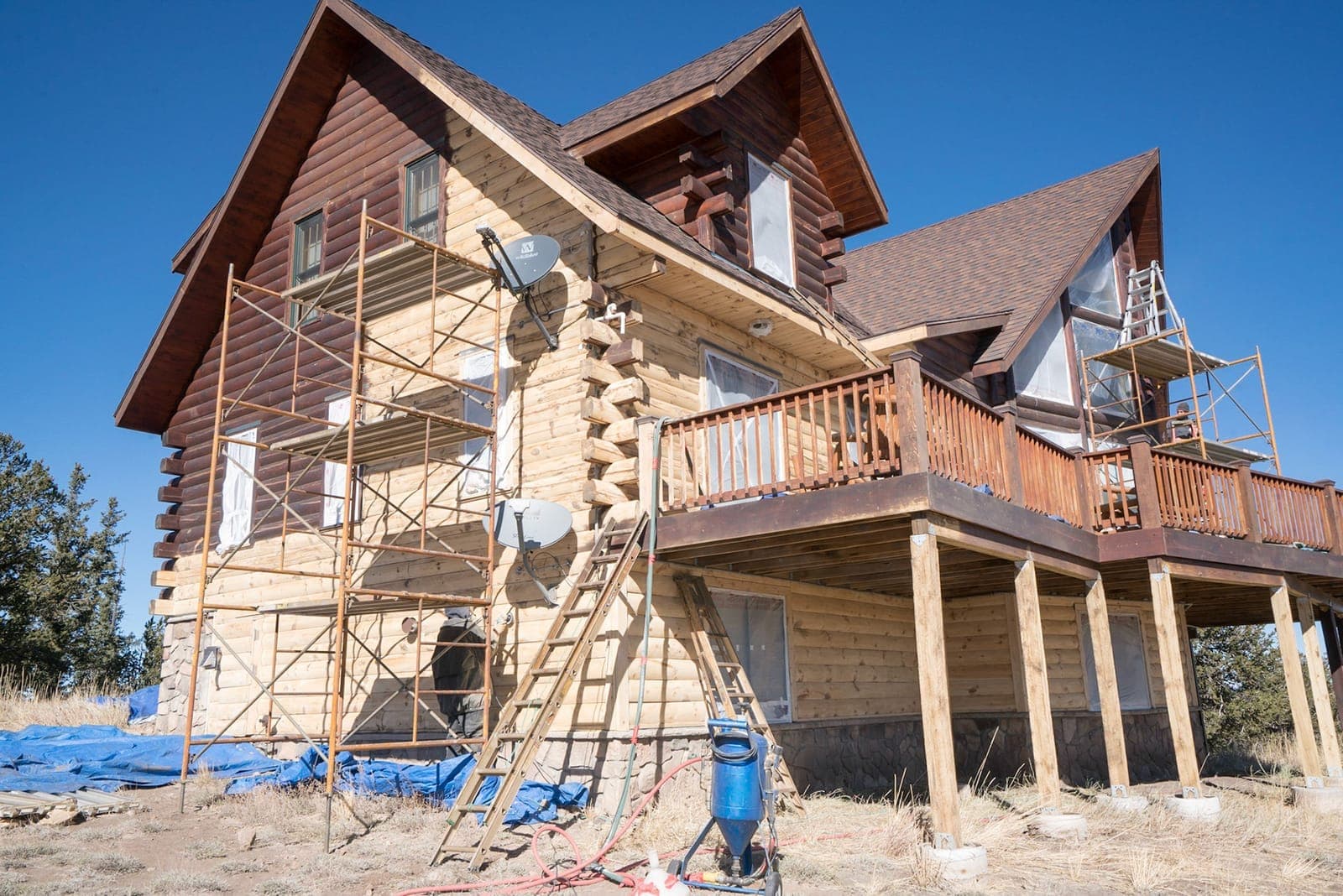
2. Media Blasting (or Stripping) the Logs: In most restorations, the old oxidized wood and failing finish must be removed to expose fresh, sound wood for re-staining. Media blasting is a highly effective method for this. It’s akin to sandblasting but using gentler media like crushed glass, ground corn cob, walnut shells, or other abrasives that won’t gouge the wood. The process involves using compressed air to shoot the media at the log surface, which strips away UV-damaged gray wood fibers, old stain, mold, and dirt. Sashco’s restoration guide notes that “media blasting with crushed glass or corn cob media” is excellent at removing even stubborn old stains and leaving a clean surface with minimal “fuzz” . Crushed glass in particular is lauded for taking off tough finishes without excessively eroding the wood, resulting in less need for secondary sanding . The advantage of media blasting over methods like chemical strippers or power washing is that blasting can reach into crevices and textured surfaces uniformly, and it doesn’t introduce water or leave chemical residue. After blasting, the logs often look brand new (“just-peeled” wood), revealing bright wood ready to absorb stain. It also opens up the wood grain for better stain penetration. Essentially, blasting resets the clock on the wood’s surface, removing years of decay and damage in a few passes. (Note: Media blasting is messy – it creates a lot of dust/abrasive material that must be collected and cleaned up. Professionals know how to do this safely with proper equipment and containment.)
3. Sanding and Cleaning: Depending on the blasting result, some additional sanding or buffing may be done to smooth the wood or remove any residual fuzziness (e.g., using an Osborn brush on a grinder). After dry prep (or if power washing was used instead), the logs should be cleaned of any remaining dust or residue. Often a log wash solution or wood brightener (mild oxalic acid) is applied to neutralize any tannins and ensure pH balance for staining. The logs are then allowed to thoroughly dry. The mantra is “absolutely bare, clean wood is essential for effective stain application” . Any dirt or mold left can interfere with stain adhesion.
4. Log Repair (if needed): Any rotten sections identified are addressed now. Small areas of rot can be treated – for example, wood epoxy (like Perma-Chink’s M-Balm and E-Wood system) can consolidate a partially rotted log end. Larger rot may require log replacement or splicing – cutting out the bad section and scabbing in a new wood piece. This is skilled work to ensure structural integrity and a good visual match. If insects were an issue, affected areas might be treated or the damaged wood removed. This step is about restoring structural soundness to the wood before sealing it up.
5. Borate Treatment: Before applying stain, many professionals apply a borate preservative to the bare wood. Borates (like disodium octaborate tetrahydrate solutions) are colorless salts that soak into wood and crystallize. They are toxic to wood-eating fungi and insects but relatively benign to people. Log Masters notes they apply borate to bare wood as a “primary defense against pests and decay” . Borates remain in the wood and will deter termites, carpenter ants, and rot fungus. This is an extra chemical insurance policy for the future, especially important if the home had any prior rot or is in an area prone to insect infestation. After applying a borate solution, the wood must dry before staining (typically a day or two).
6. Chinking and Sealant Application: If the home had old failing chinking, the restoration may involve removing the old chinking (which could be crumbling or pulling away) and replacing it with new. Often, blasting will actually remove a lot of old chinking or caulk – it just blows it out of the joints. Once the wood is prepped, new backer rod is installed in the gaps and fresh chinking is applied. This is a time-consuming but critical step: you’re essentially re-sealing the entire house. For homes that originally didn’t have chinking (e.g., milled log kits), the focus will be on sealing any revealed gaps, perhaps using caulk between logs or in checks. There’s some debate on whether to stain before chinking or chink before staining – different product systems have different order recommendations. Many modern chinking materials adhere well to stained wood, so contractors prefer to stain first (so the stain doesn’t accidentally get on the chinking later). Others do chinking first and then stain up to or even over the edge of chinking. In any case, both fresh stain and fresh chinking/caulk will be applied during the restoration. By the end, all joints should be tightly sealed.
7. Staining and Finishing Coats: Now comes re-staining the bare wood. Usually, a restoration-grade stain (often an oil-based or high-performance water-based stain) is applied in 1-2 coats according to manufacturer specs. If a two-coat system is used, it might be a stain coat followed by a clear UV topcoat (for example, Perma-Chink’s Lifeline Ultra-7 with Advance topcoat, or Sashco’s Capture with Cascade clear coat). Spraying and back-brushing is a common application method to ensure the stain penetrates and coats evenly. The fresh wood will absorb the stain readily, and the color will be much more vibrant now that the gray layer is gone. After staining, typically the chinking (if already in place) is touched up or cleaned of any stain smears. If chinking was installed first, stains are chosen that are compatible and won’t ruin the chink. Alternatively, if staining was first, the chinking is done carefully to not cover too much of the stained surface. Either way, the end result is a fully protected wall: new stain shielding the log faces, and new chinking sealing the gaps. Finally, log ends might get a special end-grain sealer, and any other finishes (like painting fascia or soffits) are done.
8. Final Seal and Inspection: Some restorers apply an additional clear coat or maintenance coat after everything settles, or they ensure that all interfaces (log to foundation, log to roof connections) are properly flashed and sealed. A quality check is performed to verify no gaps were missed – sometimes using infrared imaging to find air leaks, or simply a thorough visual inspection.
9. Maintenance Plan: The restoration team (or the homeowner) should establish a maintenance plan going forward – e.g., annual or semi-annual inspections, washing the logs every year, and scheduling the next stain refresh in a few years. This ensures the investment in restoration lasts a long time.
How these techniques mitigate damage: Each step of the restoration directly addresses the issues we talked about:
• Media blasting removes the decayed surface wood and old coatings, essentially erasing UV damage and giving new life to the logs. It also provides a good surface for new stain to adhere, which means the protective stain will last longer without flaking. By removing mold and mildew, blasting also sanitizes the surface to prevent immediate regrowth.
• Borate treating and log repairs eliminate existing decay and prevent future biological attack, halting the progression of rot and insect damage.
• New chinking/caulk closes off water entry and air leaks, which stops ongoing moisture infiltration (the root cause of rot). If the home had been leaking, this literally plugs the holes. Modern chinking’s flexibility will accommodate future movements, so the seals last.
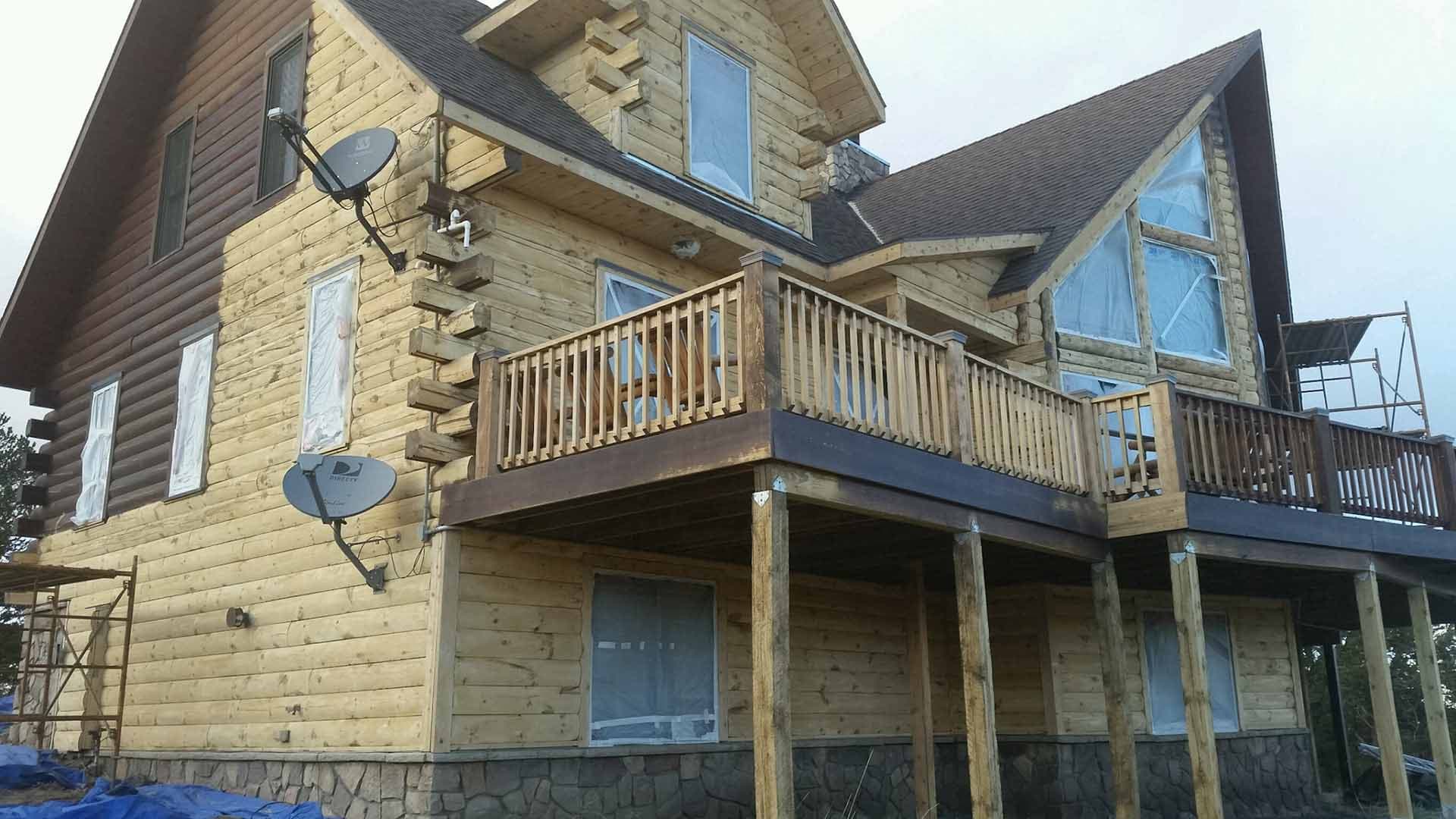
• Fresh staining reintroduces UV and water protection. The logs, now back to bare wood, get the equivalent of a new protective skin. The difference in appearance and longevity before/after is dramatic: a log home that was gray and absorbing water becomes one that is colored, vibrant, and shedding water. As an example, one restoration case in Colorado involved media blasting a neglected cabin, after which the cabin “had been neglected for many years and UV damage and water [were evident]”; once blasted and refinished, the transformation not only looked like a new home but ensured the logs were preserved from further UV/water harm .
(Figure 3: Diagram illustrating the log restoration process – starting with media blasting to remove gray wood, then staining to add color/UV protection, and chinking to seal gaps – effectively resetting and protecting the logs.)
One should note that media blasting is a professional task – improper technique can gouge wood or create a mess. Sometimes DIY owners opt for sanding or power washing instead. Power washing can work to remove finishes and clean logs, but it introduces water (which then requires a long dry time) and may not remove gray wood as fully. If power washing is used, it often needs to be followed by sanding to knock off the raised grain . Chemical strippers can remove old stain but must be thoroughly washed off and neutralized, which is tricky and messy. That’s why media blasting has become the preferred method for major restorations – it’s dry and effective. As the Sashco guide suggests, it often leaves the “most desirable wood color” and reduces secondary prep needed .
After a full restoration, a log home is essentially reset to a well-maintained state, and with consistent care, it should not need such an intensive overhaul again for a long time. It’s much like refinishing an old classic car – you strip it down and build it back up so that going forward you’re mainly doing light maintenance.
Conclusion
A log home in the Colorado mountains can last for generations – but only if it’s properly maintained. The combination of fierce UV rays, cyclic moisture, and the natural tendencies of wood will inevitably cause deterioration if logs are left unprotected. We’ve seen how round logs, flat logs, and D-logs each have their own quirks in weathering: from round logs’ vulnerable upper curve to square logs’ more uniform aging. We’ve delved into the engineering of why wood cracks and rots – UV breaking molecular bonds, water enabling fungal decay, and physical stresses tearing wood apart. And importantly, we’ve highlighted solutions: regular staining to provide UV and water shields, diligent chinking and caulking to seal every gap, and restorative techniques like media blasting to reclaim damaged wood.
In essence, maintaining a log home is about fighting off the effects of sun and water. Stain and chinking are the dynamic duo in this fight – one guarding the surface, the other guarding the seams. As one log home expert succinctly said: “protecting your logs from the elements is the best way to keep them strong and sturdy and protect them from rot and destruction.” By investing time and effort into these maintenance tasks, you preserve not just the beauty of the log home (the rich colors, the rustic character) but its very structure and value.
For Colorado log homeowners, a few extra steps are wise: use the best quality products you can, with high UV resistance; inspect your home twice a year (spring and fall) for any finish wear or sealant failures; and don’t delay small fixes. A $20 tube of caulk today can prevent a $2000 log replacement later. Keep logs clean, and manage the environment where you can – for instance, maintain gutters and overhangs to reduce water splash on logs, and consider shading or landscaping that blocks excessive sun on exposed walls .
With proper care, your log home will withstand Colorado’s bright days and cold nights, remaining a warm, sturdy shelter. Neglect, however, is the logs’ worst enemy – the consequences of not staining or chinking in this climate are inevitable fading, cracking, and decay. Fortunately, the knowledge and products available today (from breathable stains to elastic chinking and efficient blasting methods) give us the tools to beat the elements.
Your log home is a significant investment in natural wood and craftsmanship. Protect that investment with regular maintenance, and it will reward you with enduring beauty and comfort. In the world of log homes, an ounce of prevention is truly worth a pound of cure. Keep the logs sealed, and your cabin will keep you safe and cozy in the wild weather of the mountains for decades to come.
References: (Consulted sources include Sashco’s log home maintenance guides, Perma-Chink Systems resources, and log home restoration experts , among others, as linked throughout this article.)