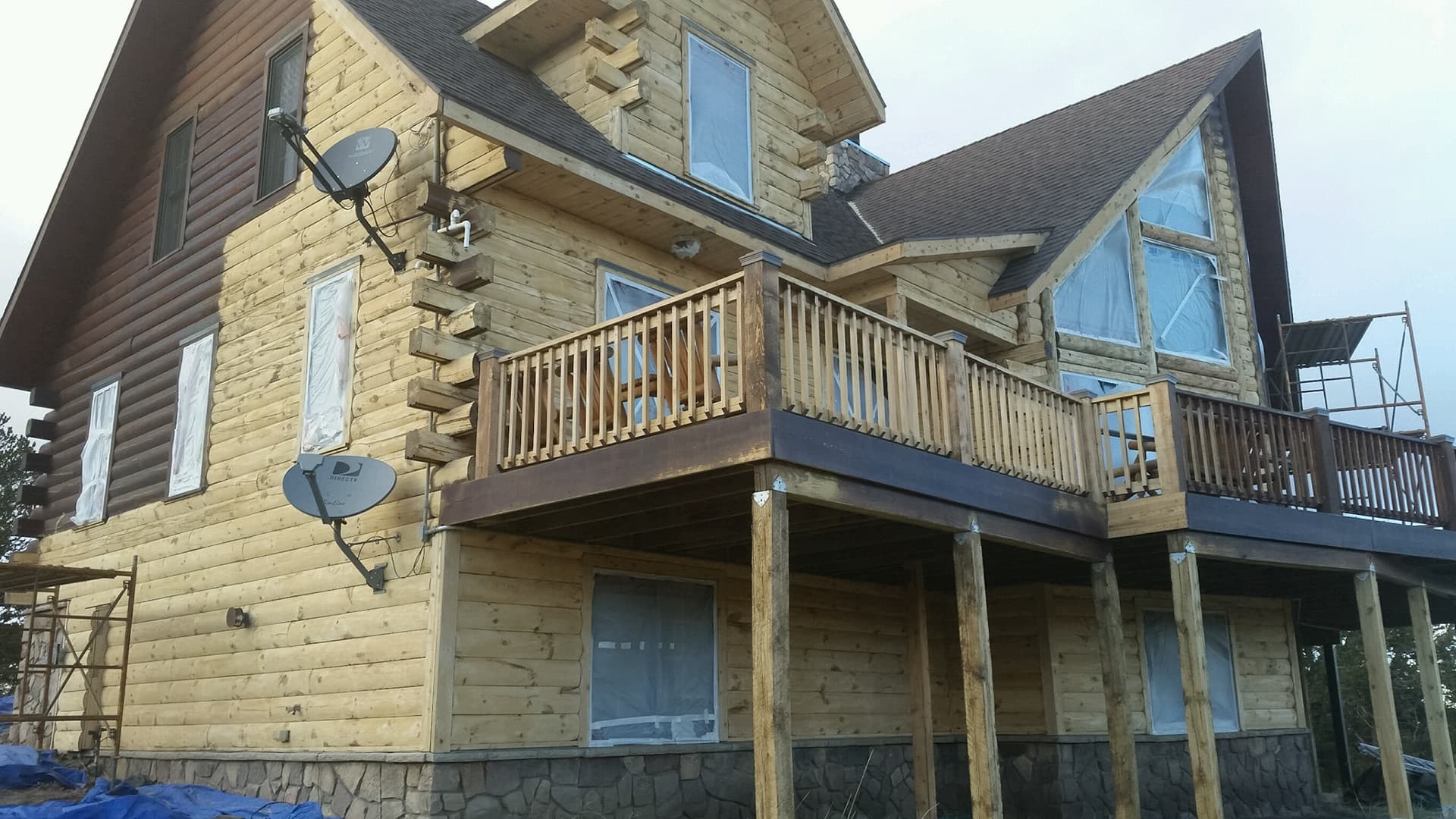
How We Calculate Square Footage on a Log Home (Hint: It Takes Pi)
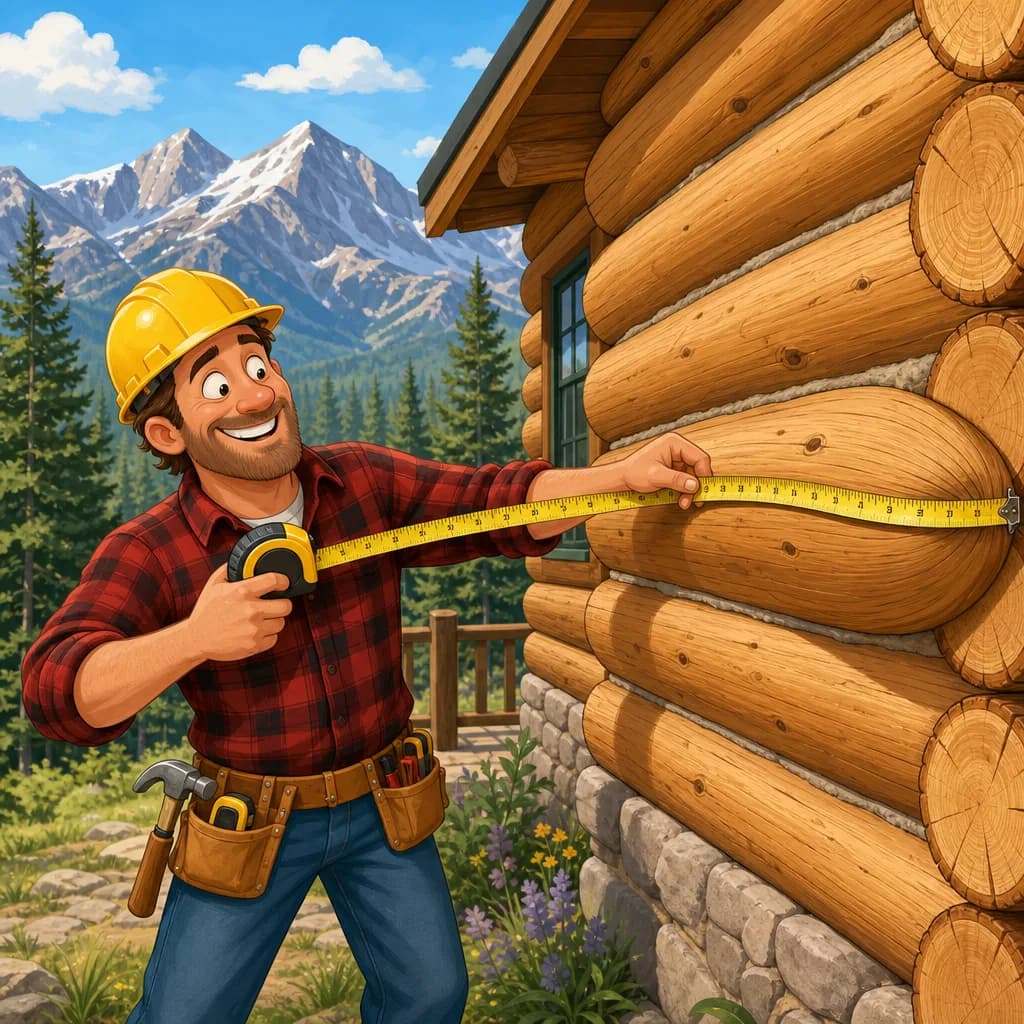
If you've gathered bids for staining, media blasting, or chinking work on your log home, you may have noticed something odd: the square footage numbers from different contractors can vary wildly — sometimes by 200% or more for the exact same house. That's not because your home changed size between visits. It's because many contractors measure a log home the wrong way.
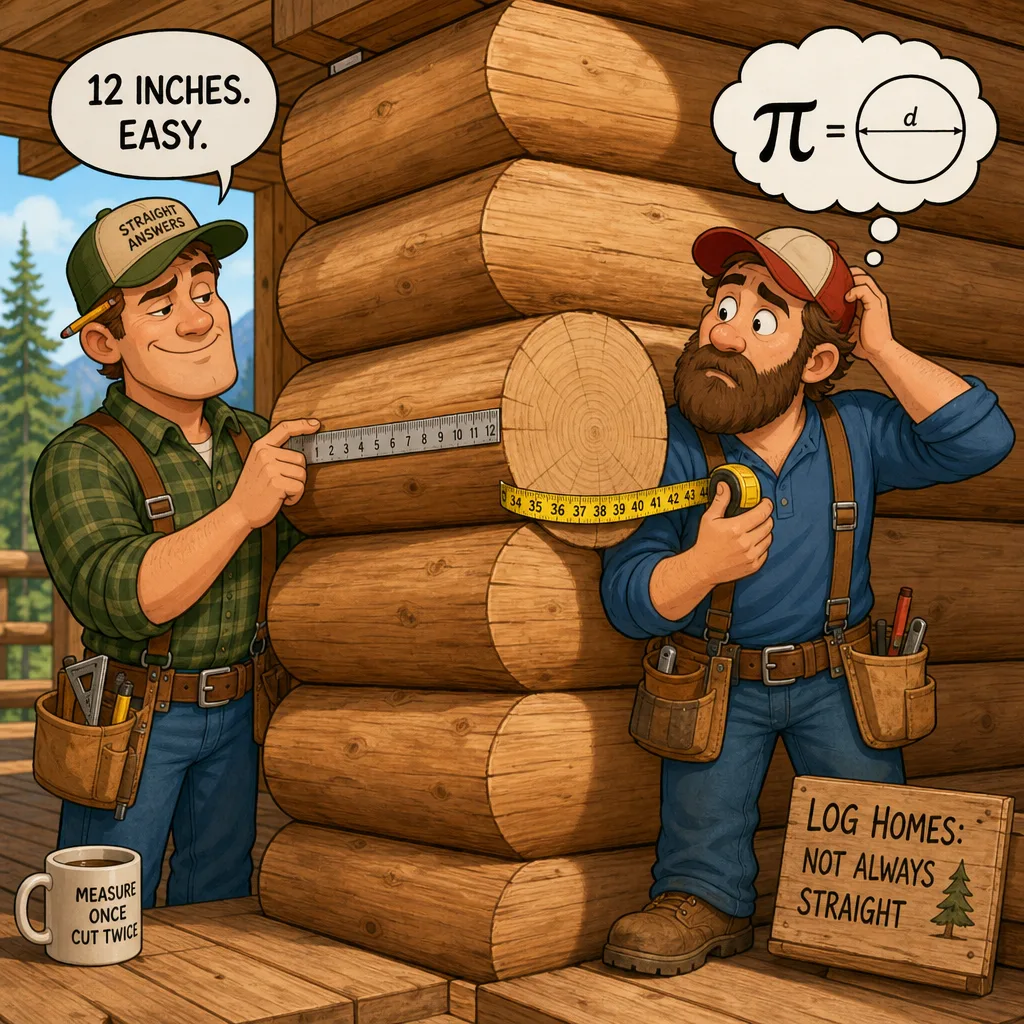
The Most Common Mistake: Measuring Logs Like Drywall
Here's what happens on most estimates. The contractor pulls out a tape measure, records the length of each wall, multiplies by the height, and calls it a day:
Wall length × wall height = square footage
That formula works perfectly for a flat surface — drywall, siding, a painted fence. But your log home isn't flat. Every single log is a cylinder, and a cylinder has dramatically more surface area than the flat plane behind it.
Think about it this way: if you stood at your wall and pressed a sheet of plywood against it, the plywood would only touch the outermost curve of each log. All of that curved surface above and below the contact point — the part that actually needs to be cleaned, prepped, stained, and sealed — gets left out of a flat measurement entirely.
The Right Way: Circumference and Pi (π)
This is where a little geometry earns its keep. The surface area of a cylinder (excluding the ends) is:
Surface Area = Circumference × Length = (π × D) × L
Where:
- π (pi) ≈ 3.1416
- D = the average diameter of the log
- L = the length of the log or wall section
The circumference — the distance all the way around the log — is what your stain, borate treatment, and prep work actually have to cover. And because π is roughly 3.14, the full curved surface of a log is more than three times its diameter for every foot of length.
A Real Example
Say a wall is 20 feet long and the logs average 10 inches in diameter:
- D = 10 in. = 0.833 ft.
- Circumference = 3.1416 × 0.833 ≈ 2.62 ft.
- Surface area per log course = 2.62 × 20 ≈ 52.4 sq. ft.
A flat measurement of that same log course (10-inch face × 20 feet) would give you only about 16.7 sq. ft. — the full cylinder is roughly three times that. Now, that 52.4 sq. ft. is the complete cylinder, and on a real wall only part of each log's circumference is exposed: the top and bottom of each log tuck into the courses above and below.
That's why the working number we actually bill against is the exposed arc of the log profile — the portion of the circumference you can see and touch — measured on your specific home rather than applied as a one-size-fits-all multiplier. Depending on the log profile and how the courses stack, the exposed surface typically works out to substantially more than the flat footprint, even though it's less than the full cylinder. The point stands either way: a flat length-times-height measurement always undercounts the surface that has to be prepped and finished.
Our Step-by-Step Approach
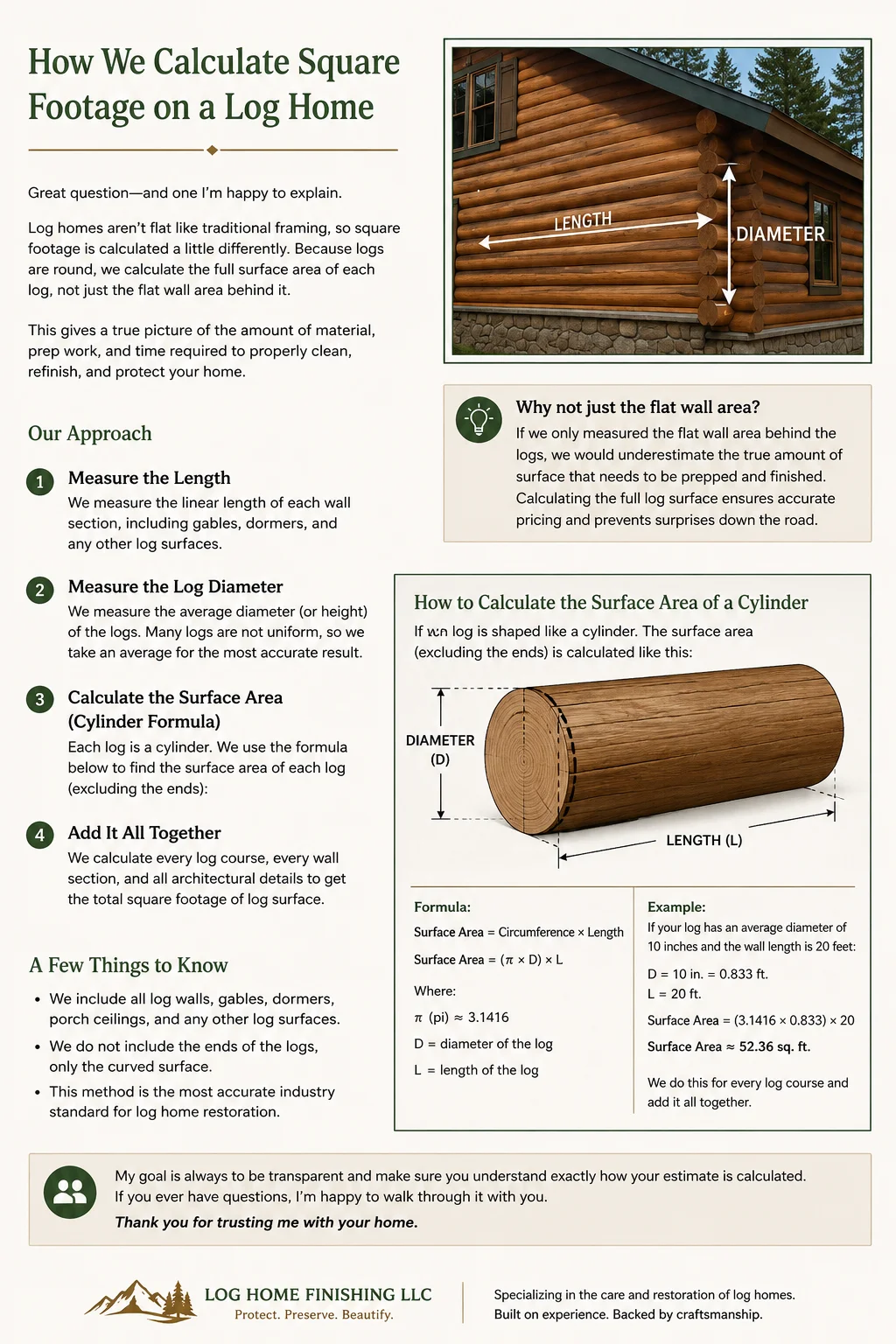
- Measure the length. We record the linear length of every wall section, including gables, dormers, and any other log surfaces.
- Measure the log diameter. Many logs aren't uniform — hand-hewn and swedish-cope logs vary along their length — so we take an average diameter for the most accurate result.
- Calculate the surface area with the cylinder formula. Each log course gets the (π × D) × L treatment, adjusted for how much of the circumference is actually exposed.
- Add it all together. Every log course, every wall section, and architectural details like porch ceilings and exposed purlins go into the total.
Why This Matters for Your Estimate
When a contractor underestimates square footage with a flat measurement, one of two things happens — and neither is good for you:
- The bid is too low, and quality suffers. The crew arrives with too little stain, too little time, and too little budget. Product gets stretched thin, prep gets rushed, and the finish fails years early.
- The bid grows mid-project. "We didn't realize how much surface there was" is a conversation nobody wants to have halfway through a job.
Stain manufacturers publish coverage rates in square feet per gallon. If the square footage going into that calculation is a third of the real number, the material estimate — and everything downstream of it — is wrong from day one.
A Few Things to Know About Our Measurements
- We include all log walls, gables, dormers, porch ceilings, and any other log surfaces in the calculation.
- We do calculate the log ends (the "crowns" that extend past the corners). They're exposed end grain — the thirstiest, most vulnerable surface on the whole home — and they take extra product and extra prep time. Skipping them is another common way a bid ends up inaccurate: a home can have dozens of log ends, and leaving them out of the math means the materials and labor to properly seal them were never priced in at all.
- This circumference-based method is the accepted industry standard for professional log home restoration — it's how material coverage, labor hours, and pricing all stay honest.
Questions to Ask Any Contractor
If you're comparing bids, ask each contractor one simple question: "How did you calculate the square footage?" If the answer is "length times height," you now know exactly why their number looks different — and why their material and labor estimates may not hold up once the work starts.
Our goal is always transparency. If you'd like us to walk through the math on your own home — logs, diameters, and all — we're happy to do it during your estimate. It's your home, and you deserve to understand exactly what you're paying for.